Your First Vegetable Bed from Scratch
2026-06-17
Starting your first vegetable bed is easier than it looks. The key is choosing the right spot, preparing the soil, and sowing crops that reward you within 3–4 weeks. This guide takes you from bare ground to first harvest without the usual beginner mistakes.
Starting your first vegetable bed is easier than it looks. The key is choosing the right spot, preparing the soil, and sowing crops that reward you within 3–4 weeks. This guide takes you from bare ground to first harvest without the usual beginner mistakes.
Choosing a spot: sunlight is everything
Most vegetables need at least 6–8 hours of direct sun per day. Spend one day watching how light moves across your yard and pick the brightest patch — in shade, yields can be 2–3 times lower. Stay away from trees and tall fences; they cast shadows and compete for moisture. Orienting the bed north–south helps plants get even light throughout the day.
Assessing and improving your soil
Grab a handful of soil and squeeze it in your fist: good soil crumbles when you press it with a finger — it neither sticks in a solid clump nor turns to dust. If the soil is heavy clay, work in 1–2 buckets of compost or rotted manure per m² plus half a bucket of coarse sand, then dig to a full spade's depth (20–25 cm). For very poor soil, add a balanced granular fertiliser at 30–40 g per m² as directed on the pack. After digging, rake the surface smooth — clods larger than 3 cm interfere with even germination.
Bed size: start small
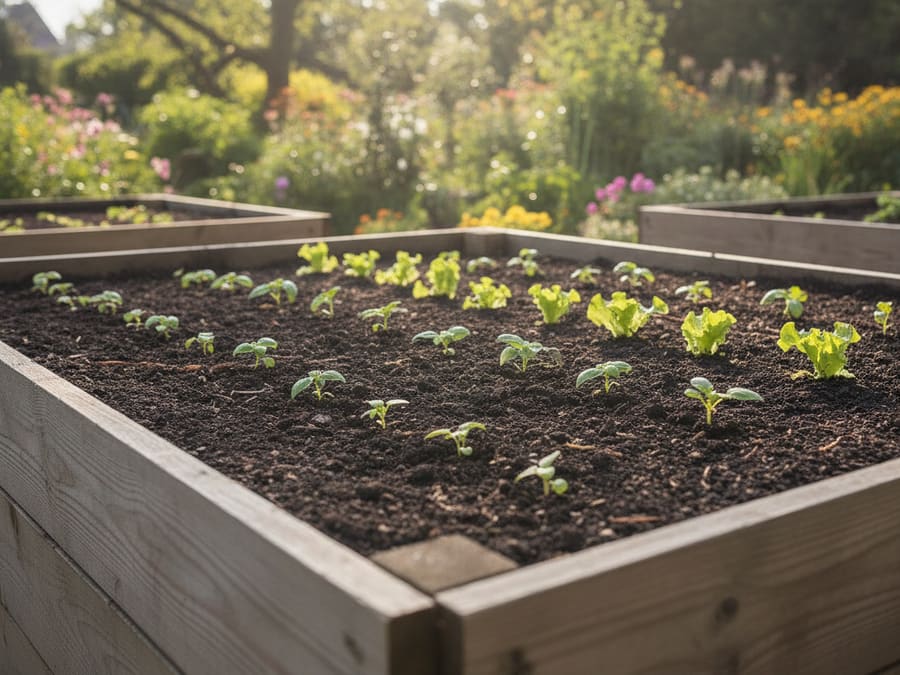
A single bed of 1 × 3 m or 1.2 × 4 m — roughly 3–5 m² — is plenty for a first season and easy to manage without stepping on the soil. Keep the width at 120 cm or less so you can reach the centre from either side. A raised bed with a 25–30 cm timber surround is an excellent choice: the soil warms up faster, fewer weeds creep in, and watering is more convenient.
What to grow: three reliable starters
Radishes are the fastest win for beginners — 20–25 days from seed to harvest; sow in rows 5 cm apart, about 1–1.5 cm deep. Leafy greens (lettuce, spinach, rocket) germinate in 5–7 days and are ready to cut in 3–4 weeks; sow thickly and thin as they grow. Courgettes (zucchini) are the most forgiving large vegetable: one plant needs a 60 × 60 cm space, starts fruiting 45–55 days after sowing, and keeps producing until the first frost. Sow all of these outdoors once the soil has warmed to at least 10–12 °C and the risk of night frost has passed.
Basic care: watering, weeding, mulching
Water deeply but infrequently: 10–15 litres at the root zone every 2–3 days is far more effective than a daily light sprinkle that only wets the surface. In hot weather (above 28 °C), water in the morning or evening so less evaporates. Weed while plants are tiny — pulling a 5–7 cm seedling is many times easier than digging out an established root. A 3–5 cm layer of grass clippings or straw mulch sharply reduces how often you need to water and keeps weeds suppressed; lay it down after the first watering.
Realistic expectations for your first season
The first season is a learning experience: some things will grow beautifully, others may not — and that is completely normal. From a 3–5 m² bed, expect your first radishes and greens within a month and courgettes by midsummer. Resist the urge to cram in too many crops: three vegetables grown with care will teach you far more than ten sown in a rush. Write down your sowing dates and when seedlings first emerge — those notes will be your most valuable tool next year.
Your first bed is the foundation: once you know how to pick a sunny spot, prepare the soil, and look after three simple crops, you will tackle everything else next season with real confidence.