Slugs and snails: holes in leaves overnight
2026-07-05
Found ragged holes in your lettuce, cabbage, or strawberry leaves in the morning with no culprit in sight? They've almost certainly hidden away — slugs and snails do their damage at night or during wet weather. Here's how to trap them, deter them, and protect your harvest without resorting to chemicals.
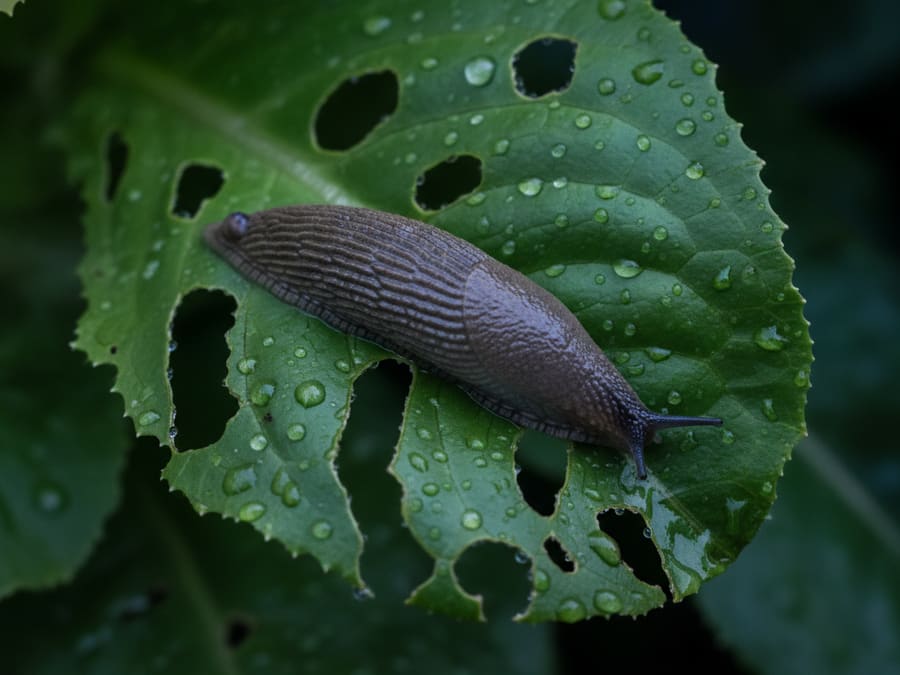
Found ragged holes in your lettuce, cabbage, or strawberry leaves in the morning with no culprit in sight? They've almost certainly hidden away — slugs and snails do their damage at night or during wet weather. Here's how to trap them, deter them, and protect your harvest without resorting to chemicals.
How to identify them
The telltale sign is a shiny silver slime trail on the soil and leaves, clearly visible in morning light. Damage always appears near ground level or on lower leaves — slugs rarely climb higher than 20–25 cm. The holes are irregular with clean edges, unlike the chewed margins left by caterpillars. If you're unsure, head out to the garden with a torch 1–2 hours after sunset: slugs will be right there on the plants.
Beer and yeast traps
Sink small containers (a cup or tin can) into the soil so the rim sits flush with the surface, then pour in 100–150 ml of dark beer or yeast solution (1 tsp yeast + 1 tsp sugar dissolved in 250 ml water). Slugs are drawn to the smell of fermentation, fall in, and drown. Check the traps every morning and refresh the bait every 2–3 days. Set out roughly 1 trap per 2–3 m² of bed.
Shelter traps and hand-picking
In the evening, lay boards, pieces of roofing felt, or damp sacking between your beds. By morning dozens of slugs will have gathered underneath — simply collect them by hand into a bucket of salted water. Hand-picking with a torch 1.5–2 hours after sunset is especially effective after rain. Three or four such evening raids can dramatically reduce the local population.
Barriers: ash, eggshells, pine needles
Slugs will not cross dry, rough surfaces. Sprinkle a 5–7 cm wide band of wood ash, crushed eggshells, or conifer needles around beds or individual plants. After rain the barrier needs renewing — wet ash loses its deterrent effect. Copper tape or copper wire wrapped around pots and raised beds creates a mild electrical impulse that stays effective for up to 3–4 weeks without replacement.
Cultural controls
Remove plant debris from beds where slugs shelter during the day, and hoe the top 3–5 cm of soil to destroy egg clusters. Avoid evening watering — a moist soil surface overnight is ideal for slugs. Water in the morning so the surface has time to dry before dark. Overcrowded plantings stay damp longer and ventilate poorly, so thin plants to their recommended spacing.
A combination of traps, barriers, and morning watering delivers results within 1–2 weeks — no pesticides needed, and no harm to bees, hedgehogs, or birds that naturally prey on slugs. The key is to act as soon as you spot the first slime trails rather than waiting for the damage to escalate.