
Spider Mites: Tiny Dots and Fine Webbing
2026-07-07
Pale speckles on cucumber leaves and a barely visible silvery webbing in the leaf axils — these are the telltale signs of spider mites. This 0.3–0.5 mm pest thrives in heat and dry air, making greenhouses and indoor windowsills especially vulnerable during July and August. The earlier you catch it, the easier it is to deal with.
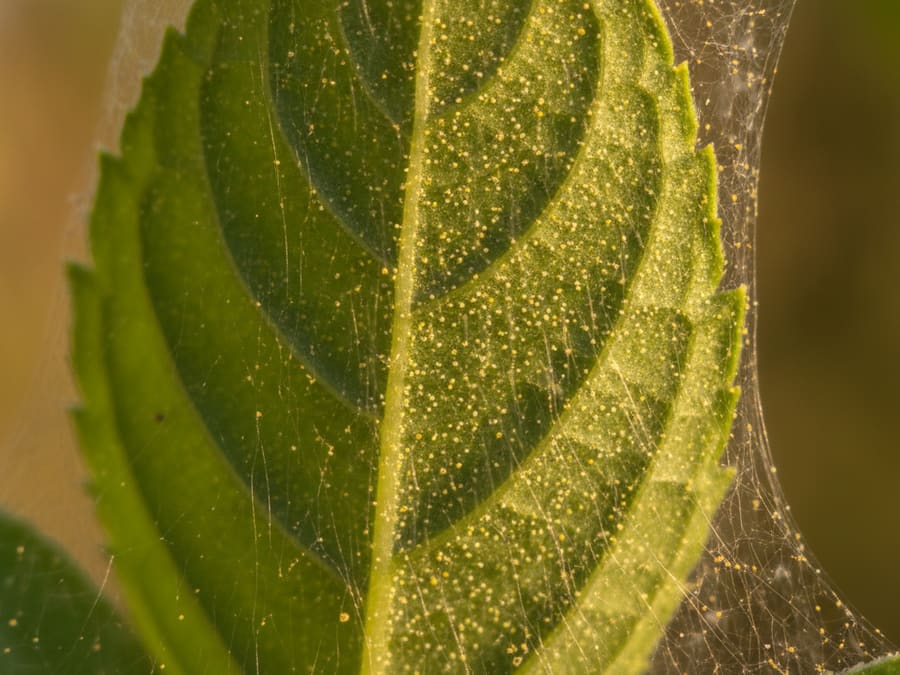
Pale speckles on cucumber leaves and a barely visible silvery webbing in the leaf axils — these are the telltale signs of spider mites. This 0.3–0.5 mm pest thrives in heat and dry air, making greenhouses and indoor windowsills especially vulnerable during July and August. The earlier you catch it, the easier it is to deal with.
How to identify spider mites
The first clue is tiny pale or yellowish dots (feeding punctures) on the upper leaf surface. Flip the leaf over: on the underside you'll find ultra-fine webbing and minuscule moving specks — the mites themselves and their eggs. On cucumbers and eggplants the damage spreads upward from the lower leaves; on houseplants it typically starts on young shoots. With heavy infestation, leaves turn yellow and drop within 7–10 days.
Conditions that favor mites
Spider mites reproduce explosively at temperatures above 28–30 °С and air humidity below 40–50 %. A single generation turns over in just 5–7 days, so populations can grow hundredfold in a month. In greenhouses the peak hits in July–August; on windowsills it's the heating season, when radiators dry out the air.
Raise humidity — your first move
Immediately mist the plants and greenhouse paths with cold water: mites cannot tolerate humidity above 70–80 %. Inside a greenhouse, hang wet burlap or place open water containers — this adds +10–15 % humidity. On a windowsill, run a humidifier or set saucers of water among the pots. Humidity alone won't finish them off, but it buys you time by dramatically slowing their reproduction while you prepare a proper treatment.
Isolate and remove mechanically
Immediately move any infested plant away from its neighbors — mites travel through the air and on clothing. Heavily affected leaves (yellowed, covered in thick webbing) should be cut off and burned, not composted. Wipe stems and petioles with a damp cloth to remove the bulk of the pests. After working with an infested plant, change your clothes and wash your hands.
Treatments: start gentle, escalate if needed
Begin with low-toxicity options: soapy water (20 g household soap per 1 litre), garlic infusion (1 head of garlic per 1 litre, steeped for 24 hours), or a ready-made pyrethrin-based acaricide — spray the undersides of leaves thoroughly. Repeat every 5–7 days for at least 3 rounds to catch newly hatched mites. For severe infestations, use chemical acaricides (Fitoverm, Actellic) exactly as directed, alternating products to prevent resistance.
Prevention
Keep greenhouse humidity at 60 % or above, ventilate regularly, and water the soil rather than sprinkling foliage. After harvest, disinfect the greenhouse thoroughly — mites overwinter in structural cracks and plant debris. For houseplants, wipe the leaves with a damp sponge every 2–3 weeks to mechanically remove egg clusters and keep populations from building up.
Spider mites are fast but predictable: keep humidity high, check leaf undersides once a week, and act at the first sign — your cucumbers and eggplants will make it to harvest in great shape.