Leaves Curling: 5 Causes and Solutions
2026-06-13
Curled leaves are one of the most common alarm signals in the garden, and your response needs to be precise rather than panicked. Some causes are completely harmless, while others demand action today. Let's work through the five main culprits and learn how to tell them apart.
Curled leaves are one of the most common alarm signals in the garden, and your response needs to be precise rather than panicked. Some causes are completely harmless, while others demand action today. Let's work through the five main culprits and learn how to tell them apart.
Heat and water deficit
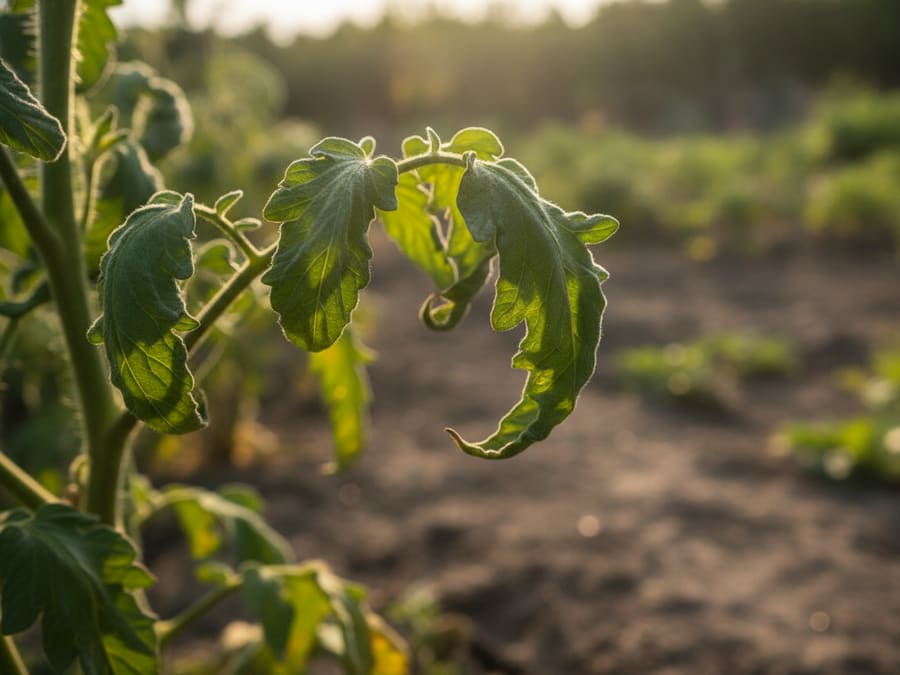
When temperatures exceed 32 °С, plants roll their leaves into tubes to reduce evaporation — this is a protective response, not a disease. Leaves curl along the central vein and unfurl again by evening. Water deeply (at least 10–15 l per mature tomato plant), mulch the soil with a 5–7 cm layer of hay or straw, and shade plants with row cover during the hottest hours (noon to 4 pm). If leaves haven't opened by morning, the water deficit is chronic — switch to watering every other day.
Pests: aphids and whitefly
Aphids colonise young shoots and suck out sap — leaves curl downward and inward, become sticky with honeydew and develop a layer of sooty mould. With whitefly, curling runs from the bottom upward, and shaking the plant releases a white cloud. Check the undersides of leaves: aphids are visible to the naked eye (green or black clusters), whitefly appear as tiny white moths. For mild infestations, wash leaves with soapy water (20 g of soap per 1 l of water) twice, five days apart; for heavy infestations, spray with a biopesticide (Spinosad, Pyrethrin-based products) according to label instructions.
Viral infections
Tobacco mosaic virus (TMV) and Tomato yellow leaf curl virus (TYLCV) cause persistent upward or downward curling that is independent of temperature and watering. Leaves are small and distorted, with a yellow-green mosaic pattern or bronze spots, and plant growth slows noticeably. There is no cure for viruses — remove infected plants and burn them, disinfect tools with a 1% potassium permanganate solution. Prevention: buy seed labelled 'TMV/TYLCV resistant' and keep aphids and whitefly under control, as they are the main vectors.
Herbicide drift
If your plot or a neighbour's has been treated with 2,4-D, glyphosate or similar herbicides, vapours can travel 50–200 m on the wind. The signs are distinctive: young leaves twist into corkscrews, petioles deform and stems may bend; in tomatoes these symptoms appear within 24–48 hours of exposure. With a small dose, the plant usually recovers — water generously, remove affected leaves and allow 3–4 weeks for recovery. With heavy exposure the plant rarely pulls through — it is better to remove it and replant.
Nitrogen excess
Too much nitrogen — particularly from applying more than 30 g/m² of urea or concentrated poultry manure — triggers explosive leafy growth: leaves are wide, dark green, fleshy and curl downward in a boat shape. Fruiting is delayed as a result. Stop all nitrogen feeds for at least 4–6 weeks, flush the soil with generous watering (10–20 l/m² for several days in a row) to leach out the excess, and apply a potassium fertiliser (potassium sulphate, 15–20 g/m²) to rebalance nutrition and encourage fruit set.
Curling leaves are the language plants use to talk to you — all you need is to learn to read it. Examine the leaves from every angle, check soil moisture, recall your last feeds and the recent weather, and in nine cases out of ten the cause will reveal itself.