Yellowing Leaves: Finding the Real Cause
2026-07-13
A yellow leaf is a symptom, not a diagnosis. Before reaching for fertilizer or fungicide, take a moment to read the full picture: which leaves are yellowing, where it starts, and whether there is a pattern along the veins. Five minutes of careful observation can save both money and your harvest.
A yellow leaf is a symptom, not a diagnosis. Before reaching for fertilizer or fungicide, take a moment to read the full picture: which leaves are yellowing, where it starts, and whether there is a pattern along the veins. Five minutes of careful observation can save both money and your harvest.
Natural aging of lower leaves
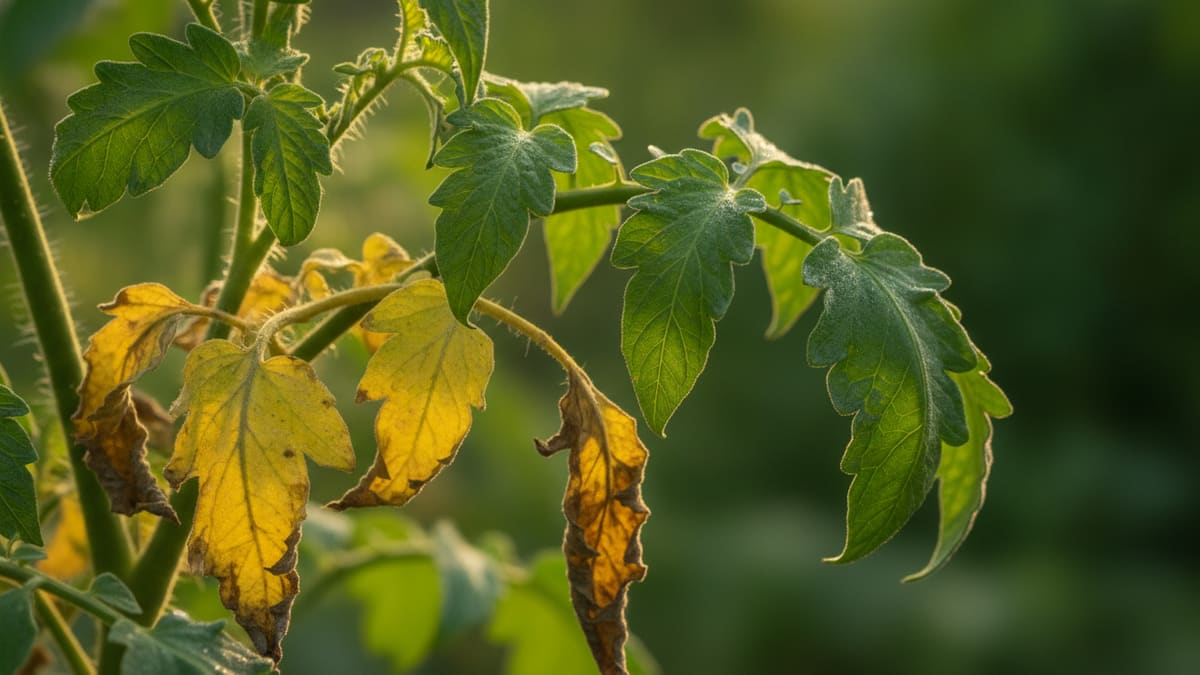
The bottom 2–4 leaves yellowing and dropping off is perfectly normal for most vegetables, tomatoes included. Those leaves have done their job: they no longer receive enough light, and the plant naturally redirects nutrients upward from them. Simply remove them to keep the stem clean and move on — if the young leaves at the top are green and firm, everything is fine.
Nitrogen deficiency
Yellowing starts with the oldest lower leaves and gradually moves up the plant; the leaf pales evenly with no spots or vein patterns. Nitrogen is mobile within the plant — when it runs short, the plant scavenges it from older leaves to feed new growth. Apply a water-soluble nitrogen fertilizer (urea at 10–15 g per 10 l of water, or diluted manure tea 1:10); you should see improvement within 5–7 days. Also check your soil pH: above 7.0, nitrogen becomes unavailable to roots even when it is physically present in the soil.
Overwatering or root rot
Leaves yellowing in a scattered pattern or in clusters, often with wilting shoots despite wet soil, is a red flag. Waterlogged roots lose the ability to absorb water and nutrients, so the plant behaves exactly as it would during drought. Let the soil dry out to a depth of 3–5 cm; for potted plants check drainage — water should flow freely through the pot within 30–60 seconds. If roots have turned brown and mushy, trim the affected sections, treat with a trichoderma-based product, and repot in fresh growing medium.
Underwatering and drought stress
During prolonged dry spells, leaves first curl, then yellow and dry from the tips and edges inward — especially on the middle tier of the plant. Soil at 5 cm depth is bone dry and pulling away from the pot walls. Water gradually in small amounts, allowing each dose to absorb before adding more. Once turgor is restored, the yellow leaves will not turn green again, but new growth will come in healthy.
Interveinal chlorosis (iron or magnesium deficiency)
The leaf turns yellow while the veins stay bright green — this is interveinal chlorosis. If it appears on young upper leaves, suspect iron: check pH (optimal range 5.5–6.5) and spray with chelated iron (1–2 g per 1 l of water). If the chlorosis started on older lower leaves, the culprit is magnesium deficiency: a foliar feed with magnesium sulfate (15–20 g per 10 l of water) will show results within 7–10 days.
Disease and insufficient light
Yellow spots with brown borders, oily patches, or powdery coatings point to fungal or bacterial disease — late blight, septoria leaf spot, or bacterial scorch. Remove and destroy affected leaves, improve air circulation, and if needed treat with a copper-based product (1% Bordeaux mixture). If the whole plant is uniformly pale yellow with sluggish growth, the cause is almost certainly insufficient light: move the plant closer to a window or add grow-light coverage for at least 10–12 hours a day.
Yellowing leaves are almost always treatable when caught early. Look at the whole plant, not just one leaf — and your garden will reward you generously.