
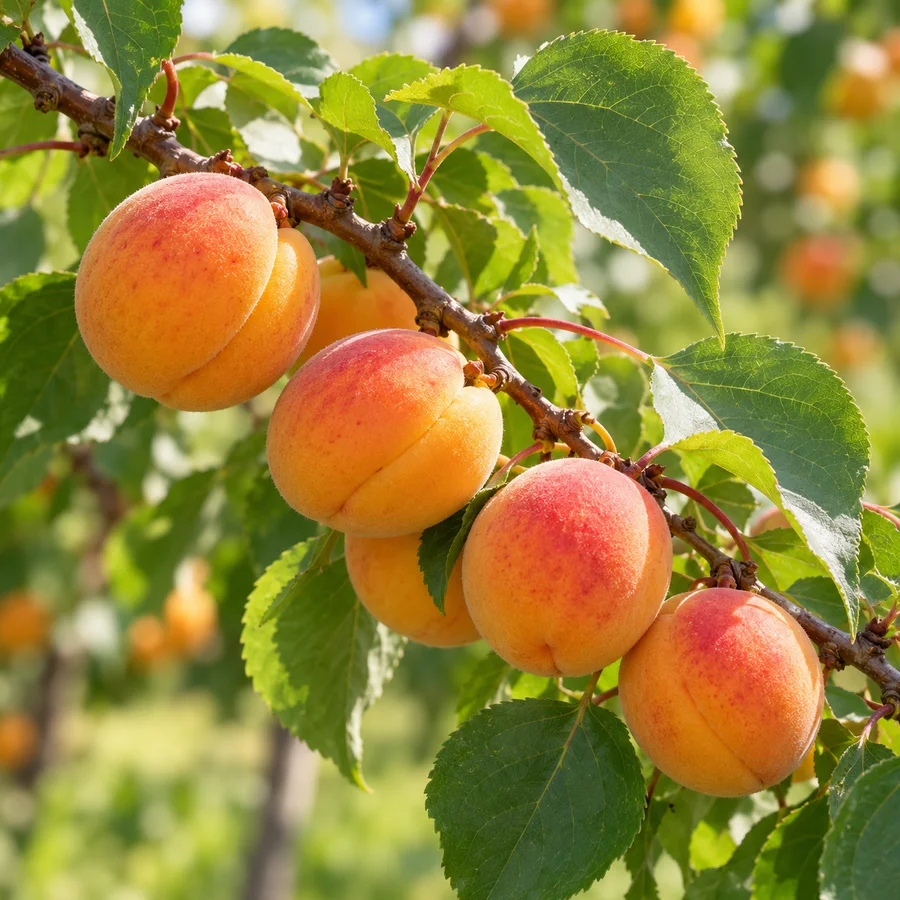
Apricot
Prunus armeniaca
A heat-loving fruit tree with delicate pink blossoms in spring and sweet orange fruit in summer. Requires good sunlight and loose, well-draining soil. Early-bearing: harvest from the third to fourth year. Cold-hardiness depends on the cultivar and region; in temperate zones, growing with winter protection or selecting hardy varieties is possible. Only the flesh of ripe fruit is edible: the kernels inside the pits, as well as leaves, bark and twigs, contain amygdalin (which releases cyanide) and are poisonous if eaten — do not eat the kernels and keep pits and pruned branches away from children, cats, dogs and horses.
Stages of growth
Planting calendar
How to care
At planting
Bone meal or superphosphate at the bottom of the hole, Compost or well-rotted manure
At planting, water abundantly until the planting hole is completely saturated. Let the soil settle naturally.
- •Prepare the planting hole a week before planting so the soil settles
- •Install a support stake 1.5-2 m high to secure the seedling
- •Soak roots in water for 2-3 hours before planting
- •Do not bury the graft union—it should be 5-10 cm above soil level
Difficulty growing
Requires basic knowledge and regular care.
Growing conditions
Nice neighbors.
Soil preparation
Planting parameters
💡Preparation Tips
- •Dig the bed to a depth of 25-30 cm
- •Add compost or humus (5-10 kg per m²)
- •If necessary, adjust pH with lime or peat
Frequently asked questions(5)
Apricot blooms very early, usually in March-April (among the first of fruit trees). Flowers are often damaged by late spring frosts. If temperature drops below -2…-4°C during flowering, flowers freeze and fall off, resulting in no harvest. To protect in regions at risk of frost, use smoke treatment, cover with agrocloth, or choose winter-hardy varieties (e.g., Triumph Northern). Excess moisture and lack of sunlight also cause flower and fruit drop.
There may be several causes: 1) Lack of a pollinating variety nearby (apricot is cross-pollinated). Plant a pollinator variety nearby (Krasnoshcheky, Triumph Northern, Chulaksky). 2) Absence of pollinators (bees) during flowering. Attract insects with flowers nearby or hand-pollinate flowers. 3) Severe damage to flowers by spring frosts. 4) Improper pruning or lack thereof—apricot requires regular crown formation. 5) Young tree (under 3-4 years will not bear fruit). 6) Depleted soil—add compost and complete fertilizer.
Moniliosis (wilting of flowers and shoots) is the main disease of apricot. Preventive measures: 1) Choose resistant varieties. 2) Ensure good drainage and crown ventilation—avoid overcrowded plantings. 3) Remove damaged and dead shoots immediately after winter (before bud break). 4) In spring, spray with fungicide twice (Skor, Chorus)—at the budding stage and after flowering. 5) In fall, remove affected fruits and leaves. If infected—prune and burn affected parts.
Apricot grows best in a bowl or sparse-tier crown form. In spring (March-April), cut back the central leader at a height of 60-80 cm, leaving 3-4 lateral branches of the first order. Each spring, remove shoots that thicken the crown and grow inward, competing with the main trunk. Limit tree height to 3-3.5 m. Apricot tolerates pruning well, but do not prune in fall—this weakens winter hardiness.
Yes, apricot is a cross-pollinated crop. Plant a minimum of two different varieties at a distance of 5-8 m from each other. Ideally, 2-3 pollinating varieties with overlapping bloom times. For example: Krasnoshcheky (mid-season) + Triumph Northern (winter-hardy) + Chulaksky (mid-late). If neighbor's trees are within 50-100 m, they can serve as pollinators. Consider regional recommendations—hardy varieties vary by zone.
Benefits and nutrition
Benefit information coming soon
Do you like the plant card?
In the application you will receive personal tasks and a plan for the season specifically for your garden.


