
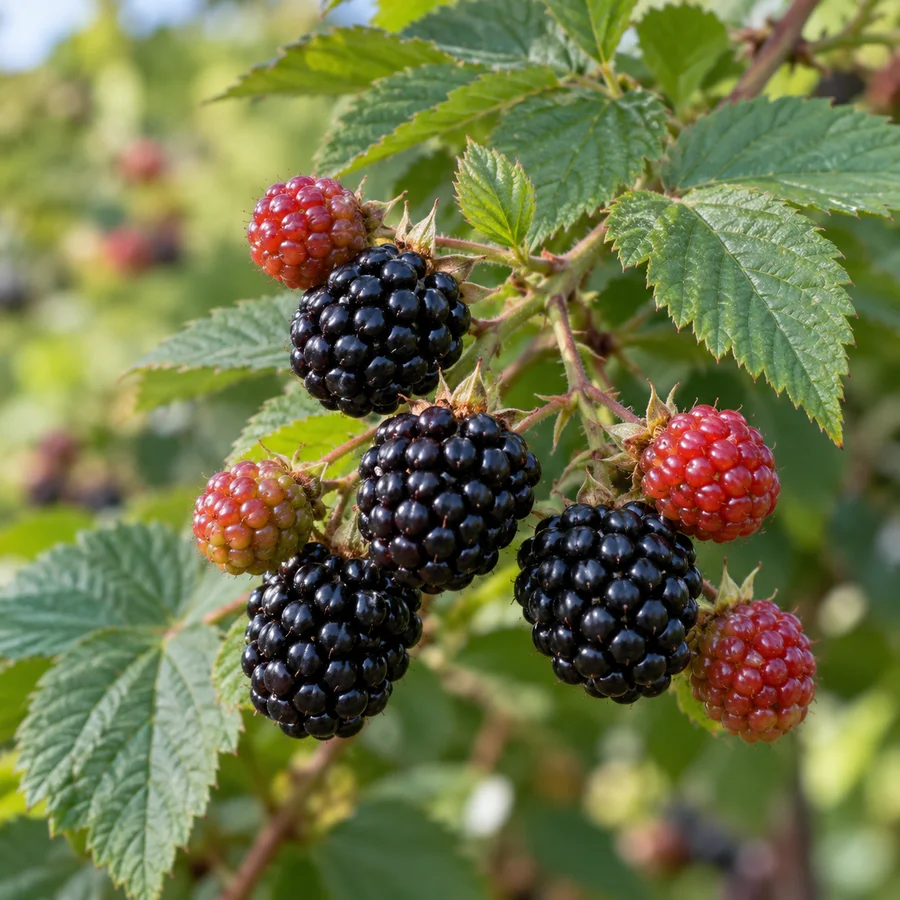
Blackberry 'Keddo'
Rubus fruticosus 'Keddo'
Thornless blackberry 'Keddo' with mid-late ripening season. The bush is vigorous with thin, flexible canes ideal for training on trellises. Berries are large, black, sweet with a pleasant tang. Excellent frost hardiness and disease resistance make this cultivar popular in the CIS region.
Stages of growth
Planting calendar
How to care
Plant with soil ball in early spring (March-April) or autumn (October-November). Pre-soak roots in water for 2-3 hours.
Abundant watering on planting day, then regular watering 2 times per week; avoid drying out the top 10 cm of soil
- •Add well-rotted compost to the planting hole
- •Set up a support or trellis immediately after planting
- •Mulch the soil around the bush with a 5-7 cm layer (wood chips or straw)
- •In the first year, prevent flowering — remove flower buds for better establishment
Difficulty growing
Requires basic knowledge and regular care.
Growing conditions
Nice neighbors.
Soil preparation
Planting parameters
💡Preparation Tips
- •Dig the bed to a depth of 25-30 cm
- •Add compost or humus (5-10 kg per m²)
- •If necessary, adjust pH with lime or peat
Frequently asked questions(5)
Blackberry flowers on second-year canes. In the first year, the bush builds vegetative mass. In the second year, overwintered shoots produce flowers and berries. Do not remove young first-year shoots — they are the future fruiting canes.
Keddo variety is naturally quite sweet. For greater sweetness: 1) ensure the bush receives at least 8 hours of direct sun daily; 2) apply phosphorus and potassium fertilizers during flowering and ripening; 3) water moderately, do not overwater (excess moisture dilutes flavor); 4) harvest fully black berries, not unripe ones.
Yes, it is essential. The Keddo variety produces long flexible canes (up to 3-4 m) that fall to the ground under the weight of fruit. Use a vertical trellis, horizontal wire, or T-shaped support system. Tie canes with soft material to avoid injuring the stems.
Yes, winter hardiness to -30°C is good for the temperate zone (zones 4-9). However, in harsh climates (Siberia, Urals), it is recommended to bend canes to the ground in autumn and cover with spunbond or evergreen branches. In the south, no protection is needed.
Completely remove all canes that fruited in the current year in autumn (August-September); keep 5-7 strong young canes of the current year — they will fruit next season. Remove weak and damaged branches immediately.
Benefits and nutrition
Benefit information coming soon
Do you like the plant card?
In the application you will receive personal tasks and a plan for the season specifically for your garden.


