
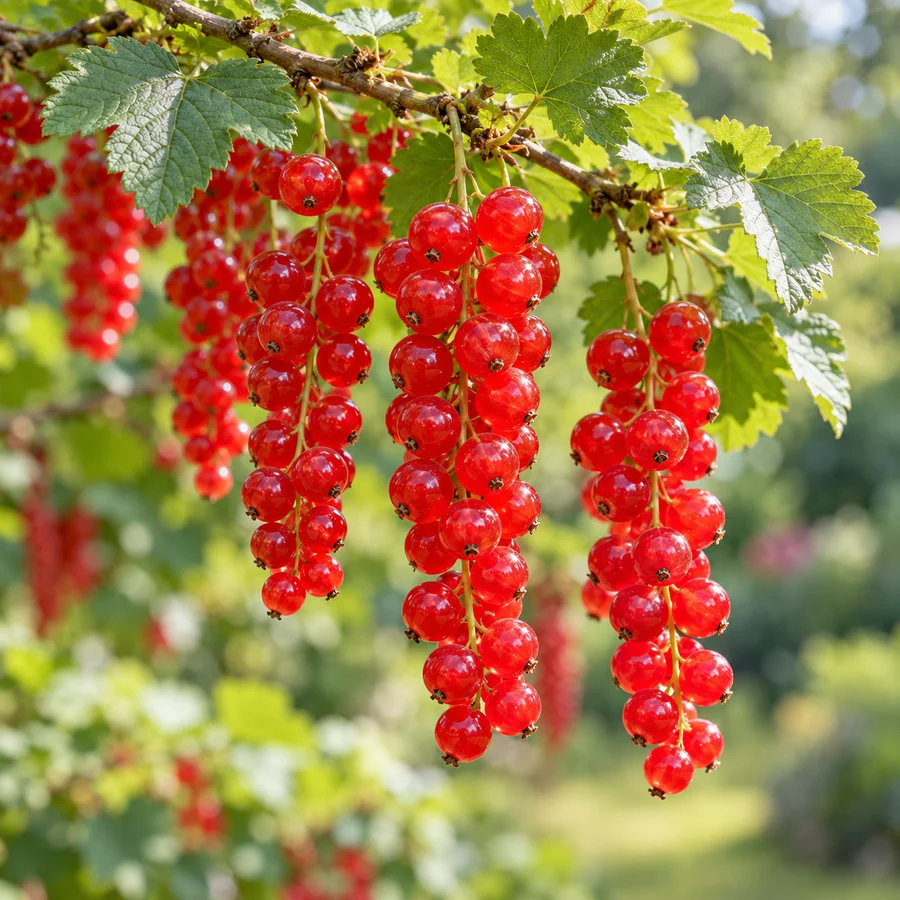
Red Currant 'Jonker van Tets'
Ribes rubrum 'Jonker van Tets'
Early-yielding, high-productivity red currant cultivar of Dutch origin. Berries are large, bright red, tart, arranged in long strands. Medium-height spreading bush, winter-hardy in temperate zones. Versatile: fresh eating, compotes, jams, juices. Self-fertile, but bee pollination improves berry set.
Stages of growth
Planting calendar
How to care
Plant in autumn (September–November) or spring (March–April). Dig a hole 50×50×40 cm, place well-rotted manure and superphosphate at the bottom. Space bushes 1.5–2 m apart.
After planting, water abundantly, then maintain soil moisture without waterlogging. In a dry spring, water 2 times per week.
- •Cover roots immediately when planting, without allowing them to dry out.
- •In the first year, remove flowers so the bush establishes well.
- •Mulch the root zone with sawdust or compost in a 5 cm layer.
Difficulty growing
Suitable for beginners. Minimal maintenance, error-resistant.
Growing conditions
Nice neighbors.
Unwanted Neighbors
Soil preparation
Planting parameters
💡Preparation Tips
- •Dig the bed to a depth of 25-30 cm
- •Add compost or humus (5-10 kg per m²)
- •If necessary, adjust pH with lime or peat
Frequently asked questions(8)
Autumn (September–November) or spring (March–April), before leaves unfold, is optimal. Container-grown seedlings are often available and can be planted in summer with regular watering. One-year-old seedlings establish better.
'Jonker van Tets' is partially self-fertile, but yield increases with cross-pollination by other red currant varieties (Early Sweet, Red Riding Hood, or another Jonker van Tets nearby). Bees and bumblebees aid fruit set.
In its planting year, the bush directs energy into rooting rather than fruiting — this is normal. First full harvest occurs in year 2–3. Remove flowers in the first season to allow good bush development.
In early spring (March–April), before buds break, remove dead, broken, and low-growing branches (below 20 cm) and old ones (older than 5–6 years). Keep 8–10 strong branches of varying ages. In summer, remove crowding shoots. Perform sanitary pruning in autumn.
Spring (April): nitrogen (urea 30 g/m²). Summer (June): superphosphate 40 g/m² + potassium chloride 20 g/m². After harvest: OMU or Kemira universal. Responds well to organic matter (well-rotted manure, compost 5 L/m² every 2 years).
Berries ripen in June–July. Harvest in dry weather in the morning, picking entire clusters. Keep in the refrigerator for 2–3 weeks, in the freezer for up to a year. Fresh berries are tart and used in jams, compotes, juices, and liqueurs.
Yes, the variety withstands frosts to -30°C and winters outdoors in the central zone (hardiness zones 3–8). Flowers tolerate spring frosts to -5°C, but severe frosts after flowering harm fruit set. In the Urals and Siberia, snow cover is beneficial.
Main enemies: anthracnose (brown spots on leaves), powdery mildew (grey coating), currant bud mite (swollen buds). Prevention: early spring copper treatment (HOM, Bordeaux mixture 1%), removal of affected shoots, good air circulation. Pests include aphids and currant flies. Treat with pesticides as needed per instructions.
Benefits and nutrition
Benefit information coming soon
Do you like the plant card?
In the application you will receive personal tasks and a plan for the season specifically for your garden.


