
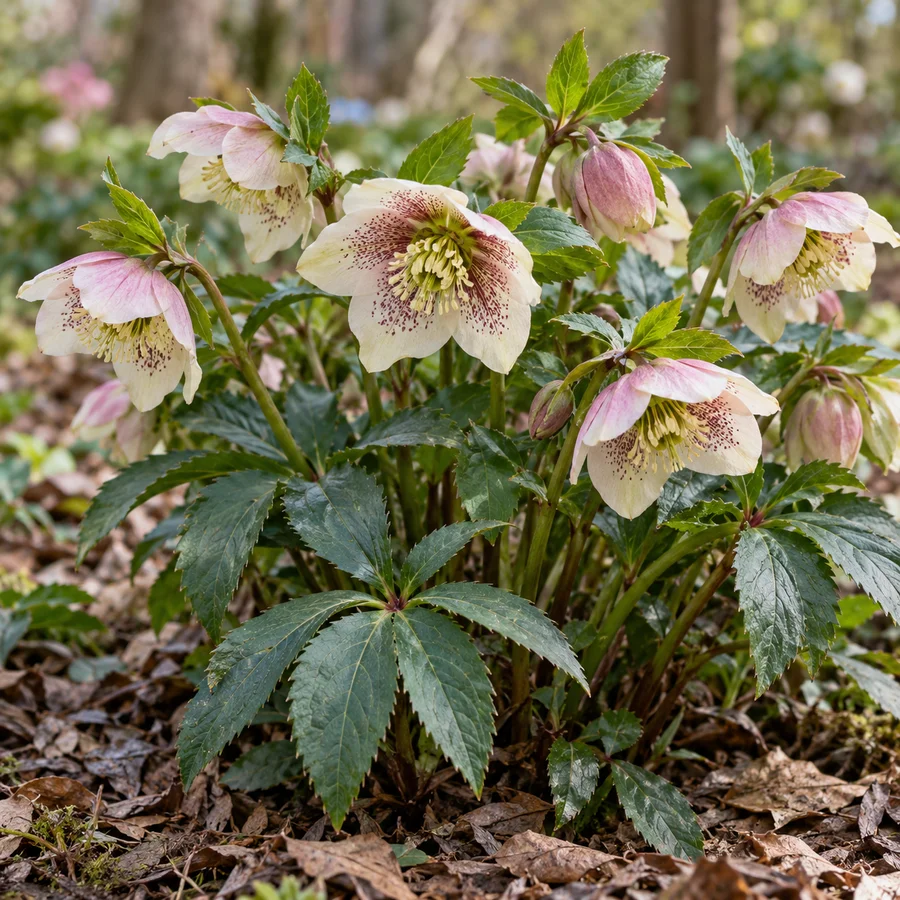
Hellebore
Helleborus
Hellebore is a cold-hardy perennial that blooms in late winter and early spring (January–March). The flowers, which come in various colors, are arranged in loose clusters and are notable for their long bloom period and frost resistance. Prefers partial shade and grows well under tree canopies. Undemanding and long-lived (10–15 years in one spot). Warning: all parts of the plant are poisonous (cardiac glycosides and saponins) — dangerous to children, cats, dogs and other animals; the sap irritates skin, wear gloves, never eat it or use it for self-treatment.
Stages of growth
Calendar in the garden
How to care
Keep soil in containers moderately moist, do not overwater. Seeds require stratification (cold 2–3 months), so sow in late autumn (November) in a cool location.
- •Hellebore seeds have slow and uneven germination (30–50%)
- •Sow with fresh seeds collected in autumn of the same year
- •Create cold stratification naturally (outdoors over winter) or in a refrigerator
Difficulty growing
Suitable for beginners. Minimal maintenance, error-resistant.
Growing conditions
Nice neighbors.
Soil preparation
Planting parameters
💡Preparation Tips
- •Dig the bed to a depth of 25-30 cm
- •Add compost or humus (5-10 kg per m²)
- •If necessary, adjust pH with lime or peat
Frequently asked questions(5)
Plant hellebore in March–April (spring) or September–October (autumn). Set divisions of mature plants 40–50 cm apart in partial or bright shade, in soil enriched with humus. Do not bury the crown. Seedlings from seeds require 3–4 years of growing before transplanting to the garden.
Young plants from seed only start flowering in the 3–4th year. If an older plant isn't flowering, possible causes are: insufficient light (transplant to a brighter location), excess nitrogen (reduce nitrogen-containing fertilizers), or overwatering. Ensure good drainage and that the soil does not become waterlogged.
Hellebore is a hardy perennial (down to −35° in Zones 3–4). It requires no winter protection and tolerates frost and snow well. In autumn, you can mulch with leaves or compost to improve soil and protect roots, but covering the stems is not necessary.
The main pruning is removing old leaves in late January (before flowering) to reveal the flowers. Remove spent flower stems in April–May if you're not collecting seeds. Beyond that, pruning is not needed; hellebore grows as a compact bush.
All parts of hellebore are toxic, containing cardiac glycosides and saponins. If plant material reaches a pet's stomach (cats, dogs), it can cause irritation, vomiting, and diarrhea. Keep the plant away from pets, wash your hands after handling it.
Role in the garden
Benefit information coming soon
Do you like the plant card?
In the application you will receive personal tasks and a plan for the season specifically for your garden.


