
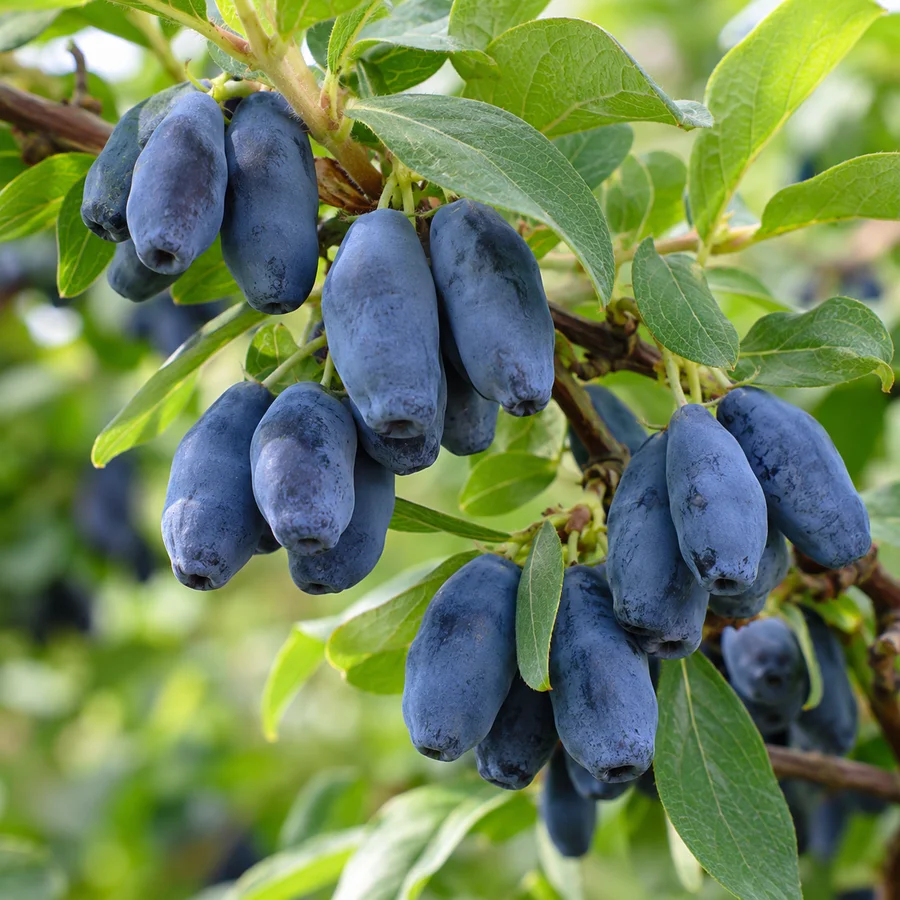
Blue Honeysuckle 'Petr 1'
Lonicera edulis 'Petr 1'
Early-season edible honeysuckle variety with dark blue berries of wonderful sweet-tart flavor. Reliably fruits with a pollinator, winter-hardy, undemanding, ideal for fresh harvest in early summer.
Stages of growth
Planting calendar
How to care
Dig a 40×40 cm pit, place fertilizer and drainage on the bottom. Plant so the root collar is level with the soil surface.
Water abundantly at planting time to settle the soil. Maintain moisture during the first week.
- •Best planted in fall (October) or early spring (March–April)
- •With spring planting, mulch with sawdust or compost
- •In the first year, it's desirable to remove flowers for better establishment
Difficulty growing
Suitable for beginners. Minimal maintenance, error-resistant.
Growing conditions
Nice neighbors.
Soil preparation
Planting parameters
💡Preparation Tips
- •Dig the bed to a depth of 25-30 cm
- •Add compost or humus (5-10 kg per m²)
- •If necessary, adjust pH with lime or peat
Frequently asked questions(5)
Yes, 'Petr 1' is self-sterile. For a good harvest, plant a compatible pollinator variety nearby, such as 'Sinaya Ptitsa', 'Tomichka', or 'Izyuminka'. They must flower at the same time.
Berries ripen in late May–early June (one of the earliest harvests in the garden). Harvest when fully dark blue. The berries are soft and easily drop, so it's recommended to spread cloth under the bush or pick them very carefully by hand.
Young bushes in the first 2–3 years require minimal pruning (remove only damaged and crowded branches). From year 4–5, begin shaping pruning: remove old stems at the base, thin out the middle of the bush. Main pruning is in late June after harvest or early spring in March.
Main causes: no pollinator neighbor; insufficient light (planted in deep shade); excess nitrogen (encourages foliage at the expense of fruit); stress from drought or waterlogging during flowering. Check if the bush is flowering — if it flowers but has no berries, it's definitely a pollination problem.
Yes, this variety is completely winter-hardy to -40°C, tolerating frosts well in central and southern Russia. No protection needed even in Siberian conditions. Only in young plants (first year) is it desirable to mulch the root zone to 10–15 cm height.
Benefits and nutrition
Benefit information coming soon
Do you like the plant card?
In the application you will receive personal tasks and a plan for the season specifically for your garden.


