
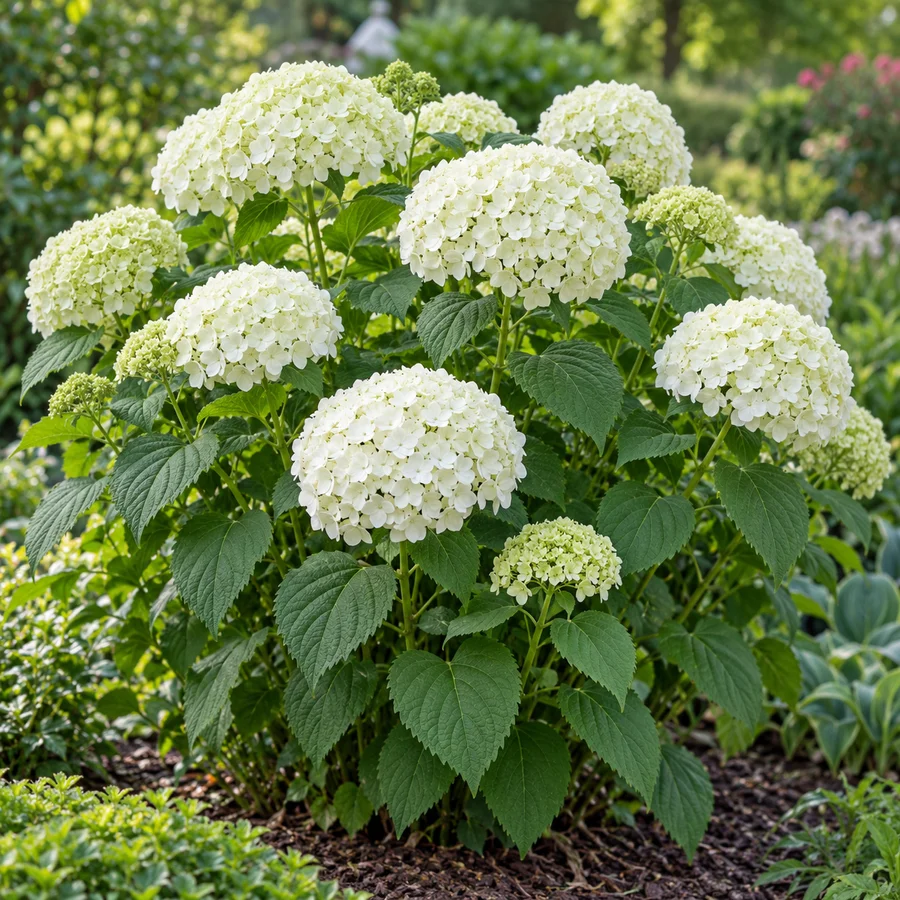
Panicle Hydrangea
Hydrangea arborescens
Ornamental deciduous shrub with large white, cream, or pink flower panicles. Blooms from July until the first frosts; very cold-hardy and sun-loving. Deficiency of nutrients can cause chlorosis and marginal leaf scorch — the plant needs micronutrients (iron, magnesium, potassium) and macronutrients (nitrogen, phosphorus). Warning: all parts of the plant are toxic — leaves, shoots and flowers contain cyanogenic glycosides, never eat them or brew them as tea; keep the shrub away from children, cats, dogs and horses, and wear gloves when pruning.
Stages of growth
Calendar in the garden
How to care
Apply to planting hole at planting time
Slow-release granular fertilizer or organic matter (compost), Micronutrients (iron, magnesium) if needed
After planting, water abundantly to settle the soil. For the first 2–3 weeks, keep the soil moist but not waterlogged.
- •Choose a location with good drainage at least 1.5–2 m from other shrubs
- •Mulch the base with peat or compost to a depth of 5 cm
- •Protect from direct sun in the heat during the first weeks if planting in spring or summer
Difficulty growing
Suitable for beginners. Minimal maintenance, error-resistant.
Growing conditions
Nice neighbors.
Soil preparation
Planting parameters
💡Preparation Tips
- •Dig the bed to a depth of 25-30 cm
- •Add compost or humus (5-10 kg per m²)
- •If necessary, adjust pH with lime or peat
Frequently asked questions(5)
This is a classic sign of iron (Fe) deficiency — common on alkaline soils or with poor drainage. Immediately spray leaves and water roots with iron chelate solution according to instructions. Repeat after 7–10 days. At the same time, check soil pH (should be 5.5–6.5) — if higher, add sulfur or peat.
Usually this is potassium (K) and/or magnesium (Mg) deficiency. Rarely — excess salt buildup in soil (overfeeding) or too dry air. Solution: 1) apply potassium magnesium or magnesium sulfate at root level (per instructions), 2) spray leaves with dilute micronutrient solution, 3) check drainage — excess moisture blocks nutrient uptake, 4) if soil is compacted, repot in fresh soil.
Spring (March–April): remove all weak, damaged, crossing branches and those growing into the shrub. Cut back healthy shoots by 1/3–1/2 their length, forming an open bowl shape. Summer (July–August): remove spent panicles. Autumn (September–October): do not prune — only remove obviously broken branches. Panicle hydrangea flowers on current-year shoots, so bold spring pruning produces more blooms.
Watering: spring–summer 2–3 times per week (or daily in heat); autumn — less frequent, only during drought. Feeding: April–May complex fertilizer (NPK 10:10:10 or similar), May–June phosphorus-potassium (for buds), July–August micronutrients (iron, magnesium, manganese — for deficiencies), September potassium-phosphorus without nitrogen. Use both mineral and organic fertilizers (compost, manure infusion). Interval — every 2–3 weeks.
Yes, this is a cold-hardy species (zones 3–9), tolerating down to –35°. However, in severe winters or windy locations, young plantings should be mulched with a thick layer (10–15 cm) of compost or peat in autumn. In sheltered locations, mature shrubs winter without protection. In Ukraine and Belarus, winter protection is usually not necessary.
Role in the garden
Benefit information coming soon
Do you like the plant card?
In the application you will receive personal tasks and a plan for the season specifically for your garden.


