
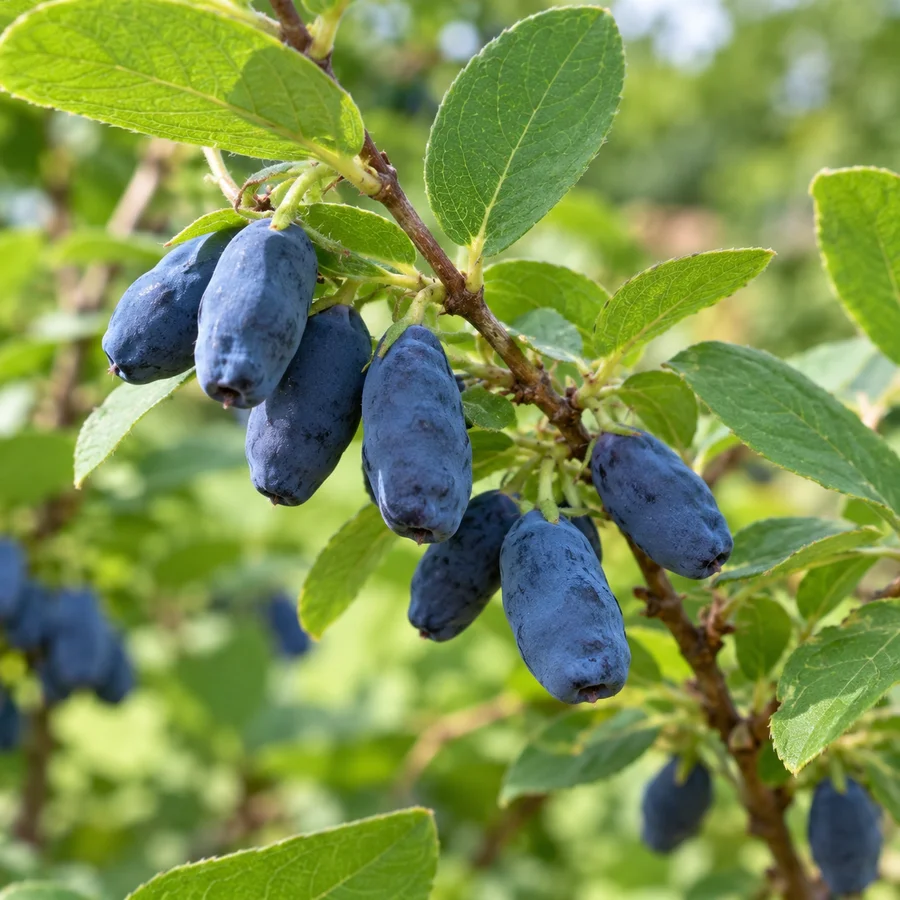
Edible Honeysuckle 'Michurinsky Wonder'
Lonicera kamtschatica 'Michurinskoye chudo'
An early-ripening edible honeysuckle cultivar with large dark-blue berries (up to 1.5 cm long) of dessert flavor. Self-fertile, frost-hardy to –50°C, a spreading shrub 1.5–1.8 m tall with elegant form. Berries ripen in late May–early June, earlier than strawberries. Unpretentious, much-awaited crop for temperate regions.
Stages of growth
Planting calendar
How to care
At planting
Compost 5–10 liters per planting hole, Phosphate-potassium fertilizers
Abundant watering at planting, then maintain soil moisture at 15–20 cm depth for 2–3 weeks of adaptation
- •Plant in early spring (March–April) before bud break or in fall (October–November) 3–4 weeks before frost
- •Planting hole 40×40×40 cm, drainage layer of gravel/sand at bottom, fill with fertile mix (compost + garden soil)
- •Keep root collar at soil level — burial risks root rot
Difficulty growing
Suitable for beginners. Minimal maintenance, error-resistant.
Growing conditions
Nice neighbors.
Soil preparation
Planting parameters
💡Preparation Tips
- •Dig the bed to a depth of 25-30 cm
- •Add compost or humus (5-10 kg per m²)
- •If necessary, adjust pH with lime or peat
Frequently asked questions(5)
When planting a 1–2 year old seedling, first berries appear in the first year (May–June), though yield is minimal (100–200 g). Maximum yield (2–3 kg per bush) is reached by the 3–5th year of bush life in the garden.
'Michurinsky Wonder' is self-fertile but rarely sets without a pollinator under incomplete pollination. Reasons: (1) insufficient pollinating bees (plant nectar crops nearby), (2) late frosts damaged the fruit set, (3) bush over-fertilized with nitrogen (excess foliage at expense of fruit), (4) drought or excess moisture during fruit set (May). It is recommended to plant another edible honeysuckle variety nearby for cross-pollination.
Yes, edible honeysuckle 'Michurinsky Wonder' is one of the most frost-hardy crops (zones 3–9, hardy to –50°C). Requires no protection even in severe Urals and Siberia winters. Conversely, in mild winters of Moldova/Ukraine dormancy may break and spring thaws may cause damage, but poses no threat.
For the first 2–3 years after planting, let the bush grow freely, removing only broken and dry branches. From the 3–4th year, after berry harvest (June–July) thin annually, retaining 10–12 strong shoots and removing old branches (over 5 years old) and those crowding the center. Completely rejuvenate the bush (cut to stump, leaving stumps 20 cm high) once every 10–15 years. Tall honeysuckle varieties are also suitable for espalier.
Edible honeysuckle is an outdoor berry plant and grows poorly indoors (insufficient light, high temperature disrupts flowering periodicity). If you still want to try: minimum 20–25 liter container, well-draining universal potting mix, bright window facing south or west, abundant summer watering, winter dormancy on a cold balcony or unheated garage at 0 to +5°C (otherwise won't survive winter). Indoor yield is sparse berries or none at all.
Benefits and nutrition
Early-ripening berries rich in vitamins C, A, B group. Deep blue color indicates high anthocyanin content with antioxidant properties. Berries can be eaten fresh, frozen, or made into jam, juice, and compote. Honey plant attracting pollinators.
*The information is for informational purposes only and does not constitute medical advice.
Do you like the plant card?
In the application you will receive personal tasks and a plan for the season specifically for your garden.


