
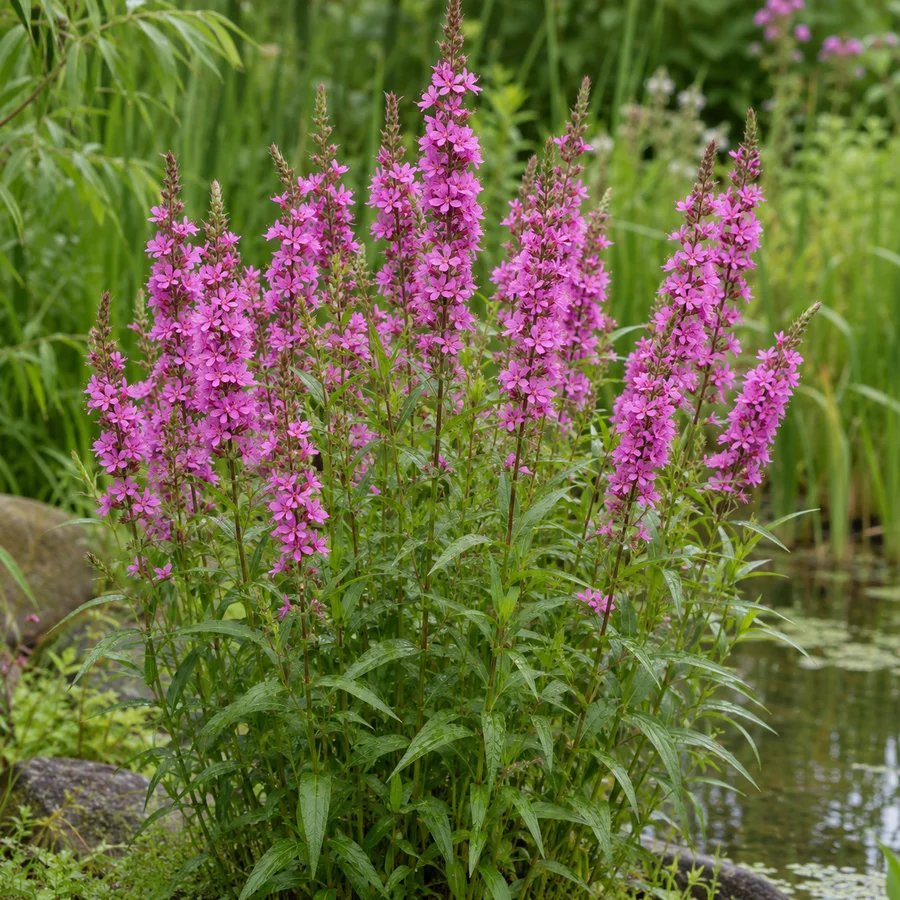
Purple loosestrife 'Pink Jam'
Lythrum salicaria 'Pink Jam'
Compact perennial shrub up to 60 cm tall with narrow green leaves and bright pink flowers arranged in dense spike-like inflorescences. Blooms from July to September, attracting bees and butterflies. Tolerates wet soils and can grow near water features and in moist borders. Winters without protection in the mid-zone of the CIS.
Stages of growth
Calendar in the garden
How to care
once at planting
balanced mineral fertilizer NPK 10:10:10
Abundant watering after planting for good root-to-soil contact. During the first week, maintain soil moisture at 60–70%.
- •Use seedlings or divisions 2–3 years old for faster flowering
- •Plant on an overcast day or in the evening
- •If planting in dry weather, water daily for the first 10 days
Difficulty growing
Suitable for beginners. Minimal maintenance, error-resistant.
Growing conditions
Nice neighbors.
Unwanted Neighbors
Soil preparation
Planting parameters
💡Preparation Tips
- •Dig the bed to a depth of 25-30 cm
- •Add compost or humus (5-10 kg per m²)
- •If necessary, adjust pH with lime or peat
Frequently asked questions(6)
Plant in spring (April–May) or fall (September–October). Choose a location with full sun or partial shade. Soil should be moist; clay loam and chernozem work well. Space plants 60–80 cm apart. Add humus and balanced fertilizer to the planting hole. Water abundantly after planting.
Purple loosestrife is one of the few garden perennials that thrives in waterlogged and boggy soils. It can be planted along pond banks, in garden low spots, and where snowmelt collects in spring. It does not rot even in standing water. This is its main advantage over most other flowers.
Main causes: insufficient sunlight (needs at least 4–5 hours of direct rays daily), poor soil (add compost and fertilizers), irregular watering (keep soil moist but not waterlogged), plant age (young plants may not flower abundantly in their first year). Also ensure the plant is not overcrowded—thin it in spring.
Three methods: divide clumps in early spring (April) or fall (September–October)—cut the rhizome so each division has 3–4 buds; take cuttings in summer (June–July)—cut 8–10 cm shoots and place in water or moist sand for 2–3 weeks until roots appear; seeds (spring sowing after cold stratification). Division is the most reliable and fastest method.
In hardiness zones 3–9 (central CIS, Ukraine, most of Belarus), purple loosestrife overwinters completely without protection. In fall, cut the plant to 10–15 cm high and mulch with peat or leaves 10 cm thick. In very harsh winters (Siberia, Urals), additionally bend shoots to ground and cover with evergreen branches. Remove protection in spring after temperatures turn positive.
In spring (April), remove all damaged and weak shoots. In summer (June–July), pinch back the tips of actively growing shoots 10–15 cm to create a more compact plant with more lateral flowering branches. Remove faded flower spikes (deadheading)—new flowers will appear on lateral shoots. In fall before frost, cut the entire plant nearly to the ground.
Role in the garden
Benefit information coming soon
Do you like the plant card?
In the application you will receive personal tasks and a plan for the season specifically for your garden.


