
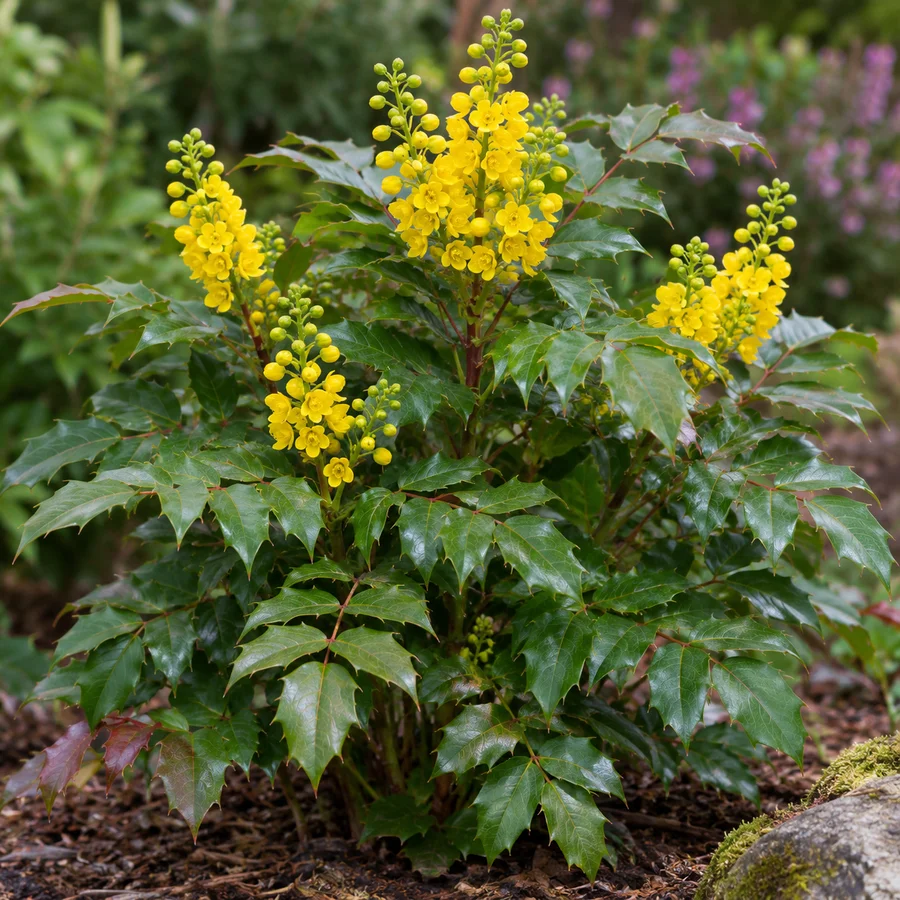
Oregon Grape, Mahonia
Mahonia aquifolium
Evergreen ornamental shrub, 1–1.5 m tall, with dense foliage. Leaves are pinnate, leathery, holly-like, dark green in summer, turning reddish or bronze in autumn and winter. Spring brings fragrant yellow flower clusters, followed by edible blue-black berries. Easy to grow, undemanding for soil and climate, hardy to -15…-20°C. Important: only the ripe berries are edible and they are very tart — eat them fresh only in small amounts, usually they are cooked; the leaves, stems, bark and roots contain the alkaloid berberine and are toxic — keep them away from children, cats, dogs and other pets.
Stages of growth
Calendar in the garden
How to care
Plant the seedling in a planting pit 50×50×50 cm, filled with fertile soil and compost.
Water abundantly immediately after planting so the soil settles firmly around the roots. Over the first two weeks, keep the soil moist.
- •Best planting time is spring (March–April) or autumn (September–October)
- •Do not bury the root collar
- •Mulch the root zone to a depth of 5–7 cm
Difficulty growing
Suitable for beginners. Minimal maintenance, error-resistant.
Growing conditions
Soil preparation
Planting parameters
💡Preparation Tips
- •Dig the bed to a depth of 25-30 cm
- •Add compost or humus (5-10 kg per m²)
- •If necessary, adjust pH with lime or peat
Frequently asked questions(5)
Plant in early spring (March–April) or early autumn (September–October). Choose a location in part shade or full sun with well-drained soil. Dig a planting pit 50×50×50 cm, filled with a mixture of soil and compost. The root collar should be at ground level. After planting, water abundantly and mulch to 5–7 cm.
Mahonia is undemanding. In the first year after planting, it requires regular watering; afterward, it is very drought-tolerant. Apply fertilizer once at the start of the growing season. The shrub grows well with minimal maintenance. Perform sanitary pruning in late winter or early spring.
Mahonia flowers in April–May with yellow flowers gathered in upright racemes. The flowers are very fragrant, with a characteristic pleasant scent reminiscent of narcissus. The flowers attract bees and other pollinators.
Yes, ripe mahonia berries are edible, but they taste very tart and astringent, not sweet like blueberries. They ripen in July–August, turning bluish-black (they become sweeter after the first frost). Eat fresh berries sparingly—a large amount of raw berries with seeds can cause stomach upset; they are usually made into jam, jelly, compote, or juice. The other parts of the plant—leaves, shoots, bark, and roots—are not eaten: they contain the alkaloid berberine and are poisonous to humans and domestic animals (cats, dogs, horses).
Oregon grape is very cold-hardy (to -15…-20°C) and evergreen. In winter, leaves often acquire a reddish or bronze tint, which is normal cold adaptation. No winter protection is required. In severe winters, young bushes can be bent down or covered with conifer branches.
Role in the garden
Evergreen ornamental shrub with fragrant yellow flowers in spring and edible bluish-black berries in summer; very cold-hardy and low-maintenance
*For reference: the plant is grown primarily as an ornamental.
Do you like the plant card?
In the application you will receive personal tasks and a plan for the season specifically for your garden.


