
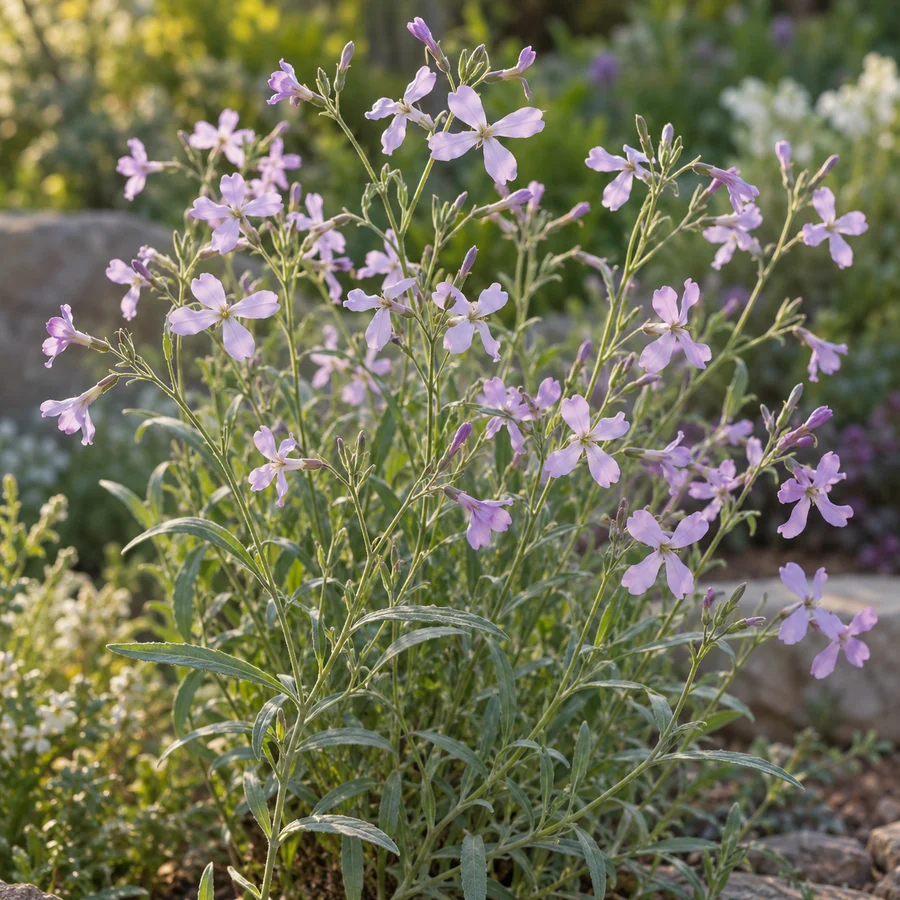
Night-scented stock
Matthiola bicornis
Annual plant 30–45 cm tall with small flowers barely noticeable during the day but fragrant at night. Flowers are pink, lilac or white arranged in loose sprays. Easy to grow from seed, ideal for evening garden sitting and balconies thanks to intense night scent. The plant is purely ornamental: flowers, leaves, pods and seeds are not edible, seeds are collected only for sowing.
Stages of growth
Calendar in the garden
How to care
Do not fertilise — nutrient-rich soil is sufficient
Keep soil moist but not waterlogged. Water with a fine spray as the top layer dries.
- •Sow seeds in late April–May directly in place, or indoors in March–April
- •Seeds germinate quickly, 5–7 days at 15–20 °C
- •Do not cover seeds with soil — they are tiny and need light to sprout
Difficulty growing
Suitable for beginners. Minimal maintenance, error-resistant.
Growing conditions
Nice neighbors.
Soil preparation
Planting parameters
💡Preparation Tips
- •Dig the bed to a depth of 25-30 cm
- •Add compost or humus (5-10 kg per m²)
- •If necessary, adjust pH with lime or peat
Frequently asked questions(5)
Spring sowing in April–May produces flowers in June–July. Summer sowing in August–September flowers in September–October. From sowing to first bloom takes 40–50 days.
It is an evolutionary adaptation: the plant attracts nocturnal pollinators (nocturnal moths, owlet moths) that are active at dusk and night. During the day it conserves energy; scent kicks in before sunset.
Yes. Use a pot at least 15–20 cm in diameter with well-draining potting compost, place on a sunny windowsill. Water moderately as soil dries. On a balcony, the evening fragrance will be enjoyed by the whole family.
These are the fruits that appear after flowering. They are narrow, elongated, and split at the ends into horn-like projections — hence the scientific name and the common name 'two-horned'. The pods contain seeds for self-seeding or collection for next year.
No. It is an annual and dies at autumn and spring frosts (below 0 °C). If growing from summer sowing through October, cover with fleece when frost threatens to extend flowering for several more weeks.
Role in the garden
Benefit information coming soon
Do you like the plant card?
In the application you will receive personal tasks and a plan for the season specifically for your garden.


