
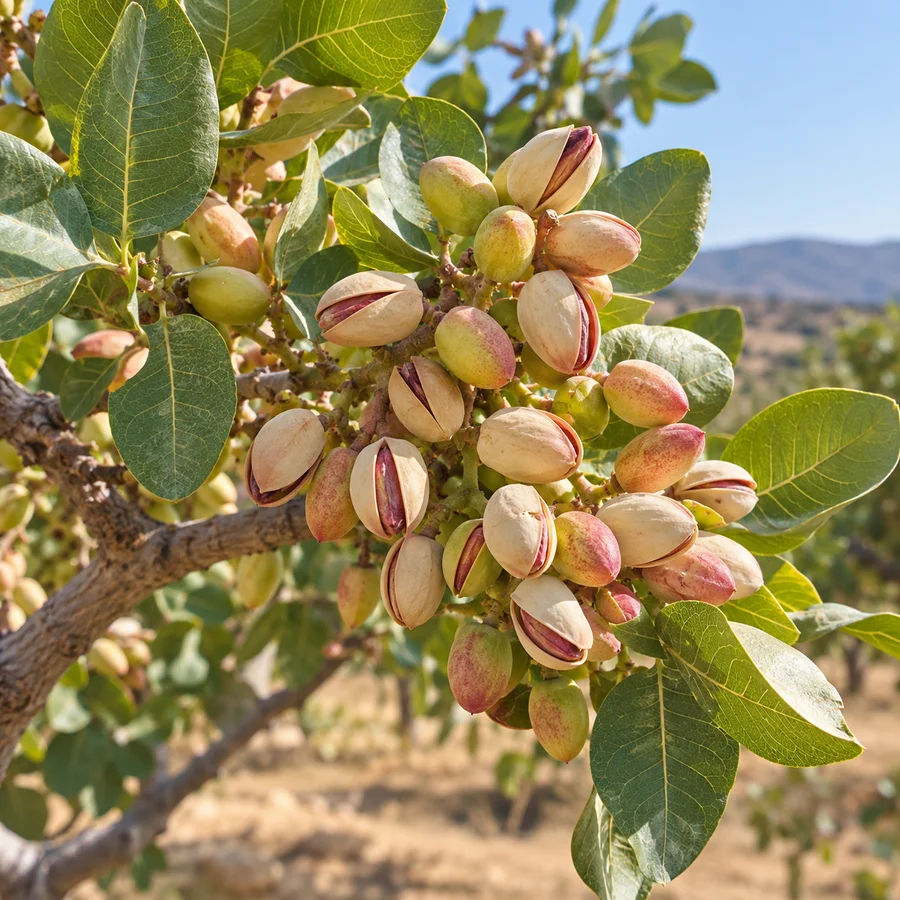
Pistachio Tree
Pistacia vera
Heat-loving fruiting tree with valuable nuts, requires a hot continental climate with dry summers. In the southern regions of the CIS (Crimea, Caucasus, southern Kazakhstan) it can be grown in sheltered locations. Only the kernels are edible: sap from the fresh fleshy hull, shoots and leaves (Anacardiaceae family) irritates skin and can cause contact dermatitis — wear gloves when hulling; the nuts are a strong allergen, and mouldy nuts (aflatoxins) must not be eaten by people or animals, while salted or roasted nuts and shells should not be given to dogs and cats.
Stages of growth
Planting calendar
How to care
2-3-year-old seedlings are transplanted in early spring (March-April) or fall (October-November). Planting depth: root collar at soil level. Do not allow grafting site to be buried.
Abundant pre-planting watering of the planting hole. After planting, regular watering every 7-10 days for the first month.
- •Select a well-drained location in full sun, protected from cold winds
- •Prepare a hole 80×80 cm, add compost and mineral fertilizers with potassium
- •Install a support stake for the young tree
Difficulty growing
For experienced gardeners. Requires special conditions and attention.
Growing conditions
Soil preparation
Planting parameters
💡Preparation Tips
- •Dig the bed to a depth of 25-30 cm
- •Add compost or humus (5-10 kg per m²)
- •If necessary, adjust pH with lime or peat
Frequently asked questions(5)
Pistachio requires hardiness zone 8-11 and hot, dry summers. Optimal locations: Crimea, Caucasus (Sochi, Krasnodar Krai), Moldova, southern Ukraine (Odesa, Zaporizhzhia regions), southern Kazakhstan (Turkestan, Mangystau). At the edge of zone 8, protection from cold winds is necessary.
When planting a 2-3-year-old seedling, first fruiting appears at 4-5 years of tree age. Full harvest (100+ kg per tree) forms by 8-10 years. Partial flowering may appear earlier, but fruits will be scarce.
Pistachio is dioecious (male and female flowers often on different trees) or has incomplete female flowers. Without cross-pollination by a compatible variety's pollen, fruits rarely set. Minimum two different varieties (one female + one male or pollinator) are essential for reliable harvest.
After harvest, spread nuts in a single layer in a protected, well-ventilated place (shed, barn) for 2-3 weeks until completely dry. Storage humidity no higher than 5-7%. Store in a dry place (cellar, pantry) in airtight containers or bags at 10-15°C. Under these conditions, nuts retain quality for 1-2 years.
In the CIS, pistachio is resistant to most pests. Main problems: aphids, spider mites (in dry conditions), leaf drop during severe drought. Bacterial and fungal diseases are rare with good crown ventilation and soil drainage. Prevention: spray with copper-containing products in spring and maintain spacing between trees.
Benefits and nutrition
Nutrient-rich nuts with high oil content, valuable for food and health. Trees live 100+ years and provide long-term yields. Excellent for creating green zones in arid regions.
*The information is for informational purposes only and does not constitute medical advice.
Do you like the plant card?
In the application you will receive personal tasks and a plan for the season specifically for your garden.


