
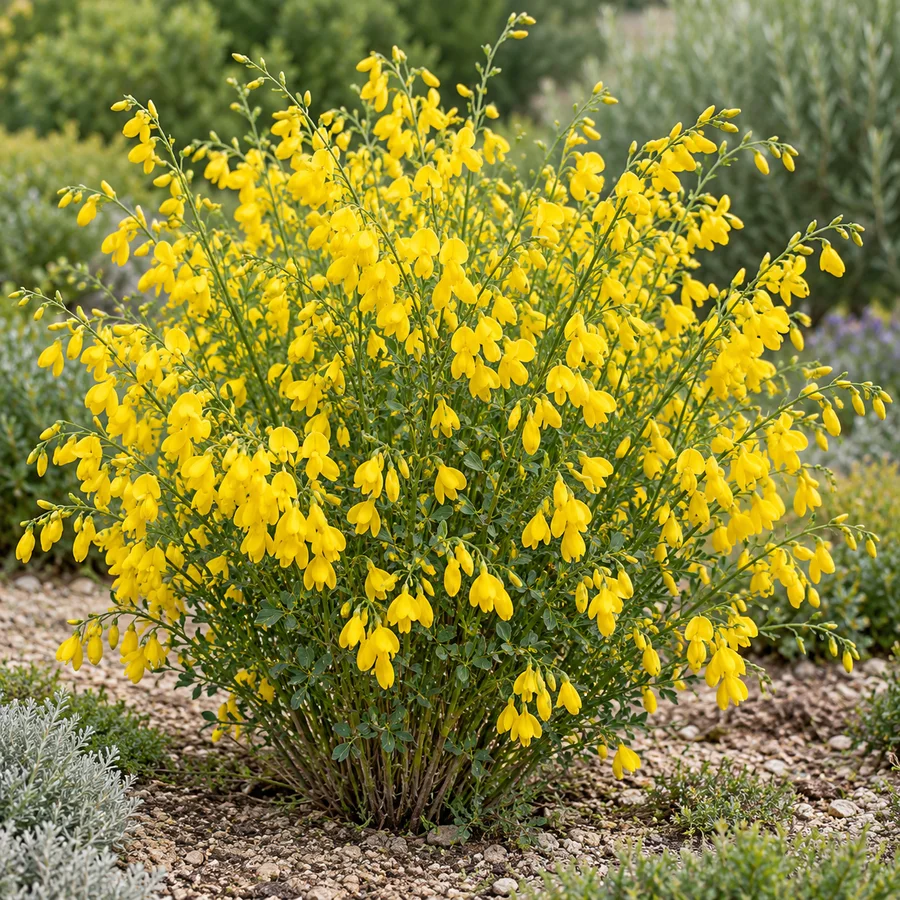
Broom
Cytisus
A deciduous or evergreen shrub with slender, elegant branches and abundant flowering. Flowers are yellow, white, pink or bicolour, gathered in racemes, appearing in May–June and almost completely covering the bush. Unpretentious, drought-tolerant, prefers sunny locations and well-drained soils. Warning: all parts of the plant are poisonous (the alkaloids cytisine and sparteine), especially the seeds in the pods; never eat any part and keep it away from children, cats, dogs and horses.
Stages of growth
Calendar in the garden
How to care
Abundant watering after planting until establishment (first 2–3 weeks), then less frequently
- •Dig a planting hole 2–3 times larger than the root ball
- •Place drainage material (gravel, expanded clay) at the bottom of the hole
- •Do not bury the root collar
- •Mulch the tree circle
- •Install a support for young plants in windy locations
Difficulty growing
Suitable for beginners. Minimal maintenance, error-resistant.
Growing conditions
Soil preparation
Planting parameters
💡Preparation Tips
- •Dig the bed to a depth of 25-30 cm
- •Add compost or humus (5-10 kg per m²)
- •If necessary, adjust pH with lime or peat
Frequently asked questions(5)
Main flowering occurs in May–June. Yellow, white, pink, or bicolour flowers completely cover the thin shoots. In southern regions of the CIS, weak repeat flowering is possible if faded flowers are removed.
The plant is drought-tolerant. Young seedlings require regular watering for the first few weeks. Adult shrubs are watered only during dry periods. Overwatering and poor drainage cause root rot.
Broom prefers full sun (minimum 6–8 hours of direct sunlight daily). In shaded locations, flowering is weak. Soil should be well-drained, light, sandy or rocky, and acidic to neutral (pH 5.5–7.0).
Light formative pruning immediately after flowering (July) encourages denser growth and compact shape. Heavy pruning of old shoots (older than 3–4 years) rejuvenates the plant. Avoid drastic pruning to old wood — the shrub may not recover.
Most broom species are hardy to -20…-30°C. Young seedlings in severe winters of the first year should be protected with evergreen branches or burlap. Adult shrubs winter without protection. Upper shoots may be frost-damaged, but the shrub recovers quickly.
Role in the garden
Benefit information coming soon
Do you like the plant card?
In the application you will receive personal tasks and a plan for the season specifically for your garden.


