
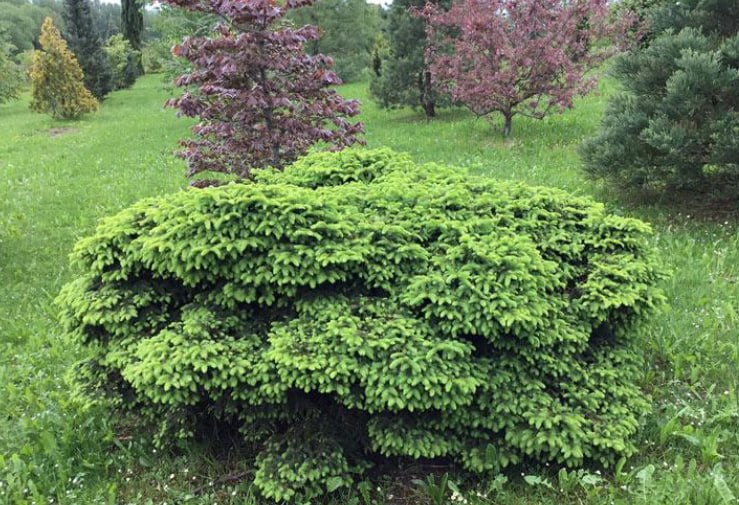
Spruce 'Nidiformis'
Picea abies 'Nidiformis'
A compact ornamental spruce cultivar with a distinctive nest-like crown form. Slow-growing evergreen shrub reaching 1–1.5 m, perfect for alpine gardens, rock gardens, and heather gardens. Dark green foliage becomes denser and more refined year after year.
Stages of growth
Calendar in the garden
How to care
Plant in early spring or early autumn in loamy, well-drained soil. Dig a hole 1.5 times larger than the root ball. Root collar must be exactly at soil level.
Generous watering 2–3 times per week, soil should remain moist but not waterlogged. Mulch with peat (5–7 cm) around the base.
- •Protect young seedlings from direct midday sun in the first month with shade cloth
- •Avoid drying out the root system
- •Stake if strong winds occur
Difficulty growing
Suitable for beginners. Minimal maintenance, error-resistant.
Growing conditions
Soil preparation
Planting parameters
💡Preparation Tips
- •Dig the bed to a depth of 25-30 cm
- •Add compost or humus (5-10 kg per m²)
- •If necessary, adjust pH with lime or peat
Frequently asked questions(5)
Optimal timing is early spring (March–April) or early autumn (September–October). Spring planting is preferable in cold regions to allow root establishment. Avoid summer heat planting and late autumn before frost.
Full sun (minimum 6 hours direct light) or light partial shade. Well-drained peaty or loamy soil with pH 4.5–6.0. Protection from strong winds. Uniform moisture without waterlogging.
Young seedlings (1–2 years) need 2–3 waterings per week. Mature plants need 1–2 waterings weekly depending on rainfall. More frequent watering during heat waves. Check soil moisture at 10 cm depth.
Pruning is minimal—this cultivar has a beautiful natural form. Perform sanitary pruning of dead and damaged branches in early spring. Light thinning inside the crown for better air circulation is acceptable but don't overdo it.
This cultivar is very hardy (to −30°C) and doesn't require winter protection for mature plants. Young seedlings in their first year should be mulched with peat (8–10 cm) and loosely covered with evergreen boughs if needed. In severe winters with heavy snow, wrap the crown with twine to prevent branch breakage.
Role in the garden
Benefit information coming soon
Do you like the plant card?
In the application you will receive personal tasks and a plan for the season specifically for your garden.