
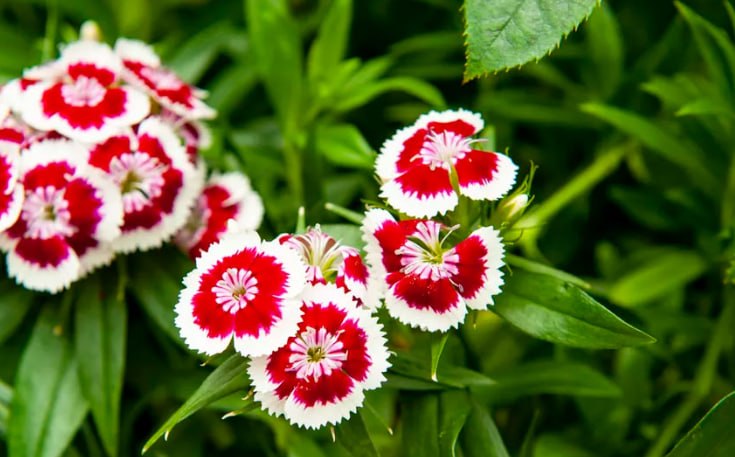
Sweet William
Dianthus barbatus
Sweet William is a biennial flower with dense clusters of blooms on sturdy stems 30–60 cm tall. Flowers are grouped in umbels, colored in bright red, pink, white, burgundy, often with contrasting edges. Blooms in summer and autumn, attracts bees and butterflies. Undemanding, grows well in full sun and partial shade.
Stages of growth
Calendar in the garden
How to care
Careful watering, soil slightly moist
- •Use quality substrate for sowing (peat, coconut, vermiculite)
- •Sweet William seeds do not require stratification
- •Before sowing, soak seeds in room-temperature water for 1-2 hours
Difficulty growing
Suitable for beginners. Minimal maintenance, error-resistant.
Growing conditions
Nice neighbors.
Soil preparation
Planting parameters
💡Preparation Tips
- •Dig the bed to a depth of 25-30 cm
- •Add compost or humus (5-10 kg per m²)
- •If necessary, adjust pH with lime or peat
Frequently asked questions(5)
Sweet William is a biennial. It is sown in spring (February–March) for flowering next year, or in summer (August–September) for flowering late in the same season. Seedlings are planted in open ground in May (after last frost) or in August in their permanent growing location.
Keep seedlings in a bright location at 18–20°C. Water as the top soil layer dries. Pinch the tips if seedlings stretch. Harden off seedlings 10 days before planting by moving them outside. Feed once every 2 weeks with a complex fertilizer.
The plant loves full sun or light partial shade, tolerates various soils well, but grows better on loams and chernozems with pH 6.0–7.5. It does not tolerate water stagnation and acidic soils. Hardy to -20°C without cover in zones 3–4.
Regularly deadhead faded flower clusters. This prevents seed formation and directs the plant's energy to producing new flowers. Feed the plant every 2 weeks with phosphorus-potassium fertilizer to stimulate abundant flowering.
It is a true biennial. In the first year it forms a leaf rosette, in the second year it blooms and produces seeds. After flowering, the plant typically dies. However, in warm climates it can be grown as an annual or short-lived perennial.
Role in the garden
Benefit information coming soon
Do you like the plant card?
In the application you will receive personal tasks and a plan for the season specifically for your garden.