
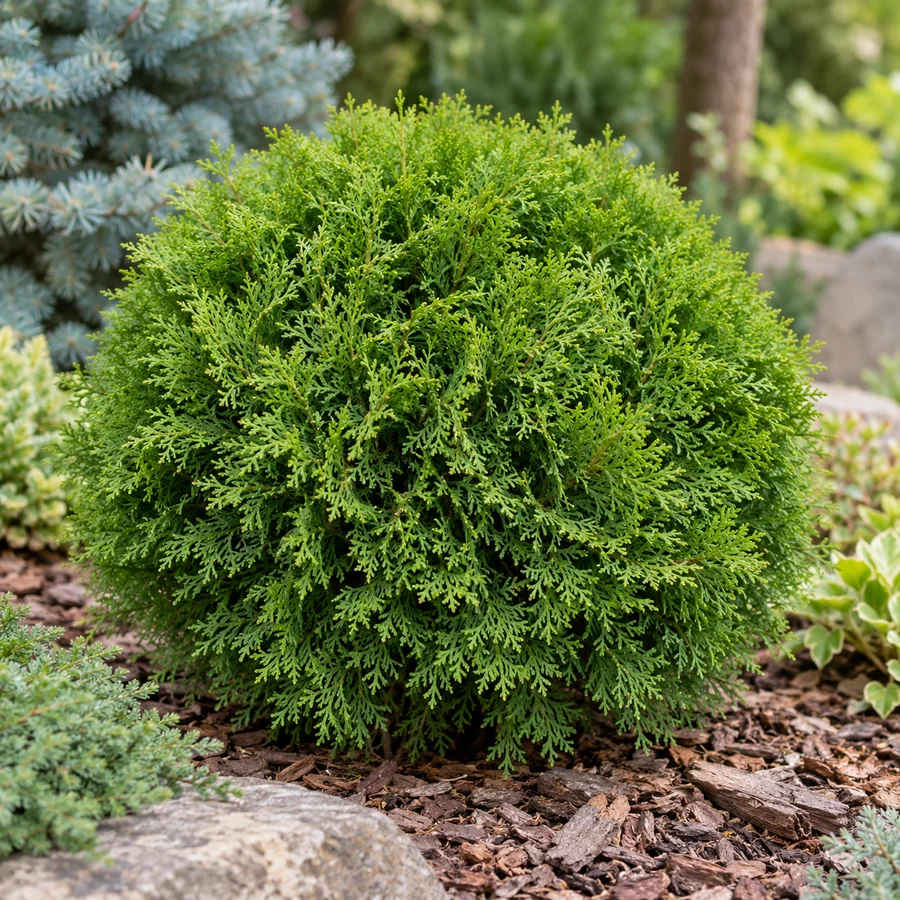
Eastern Arborvitae 'Danica'
Thuja occidentalis 'Danica'
A compact evergreen shrub from the conifer family with a spherical crown. Thuja 'Danica' grows only 80–100 cm in height, making it ideal for small gardens, containers, and alpine rock gardens. Its soft, light-green or yellow-green foliage turns brownish-bronze in winter. Undemanding, frost-hardy (to –35°C), and long-lived. Warning: the foliage, shoots, and cones of arborvitae are toxic if eaten (thujone and other terpenes) — never use them as food, tea, or tinctures and do not self-medicate with them; keep the plant and its clippings away from children, cats, dogs, and other animals.
Stages of growth
Calendar in the garden
How to care
Do not transplant the seedling in its first year; plant in open ground in its permanent location in spring (April–May) or early autumn (September).
Regular watering for the first month after planting; keep soil moist but not waterlogged. In summer, water 2–3 times per week during dry spells.
- •Protect the young plant from direct sun for the first 2–3 weeks (use shade cloth).
- •Mulch the root zone with sawdust or peat to a depth of 5–7 cm.
- •Avoid soil compaction around the root collar.
Difficulty growing
Suitable for beginners. Minimal maintenance, error-resistant.
Growing conditions
Nice neighbors.
Soil preparation
Planting parameters
💡Preparation Tips
- •Dig the bed to a depth of 25-30 cm
- •Add compost or humus (5-10 kg per m²)
- •If necessary, adjust pH with lime or peat
Frequently asked questions(5)
The best timing is spring (April–May) or early autumn (September). Spring planting is preferable since the plant establishes roots better before winter and is already prepared for it. Container-grown seedlings can be planted from spring through September, but avoid the summer transition period (July–August) and late autumn.
Yes, this is one of the main advantages of the variety. Use a pot of 15–20 liters with drainage holes and nutrient-rich conifer mix (peat, sandy loam, gravel). Water more frequently in summer (every other day in heat), minimally in winter. Repot into a container 3–5 cm larger every 2–3 years.
This is normal for this variety. Frost and wind cause foliage to take on a bronze or brownish tint. In spring (March–April) when temperatures rise, the color returns to normal. This is not disease or plant death—simply a protective stress response.
Use specialized conifer fertilizers with predominant micronutrients (Fe, Mg, Mn) and low nitrogen content (otherwise foliage becomes loose and less frost-hardy). Apply fertilizer once at the beginning of the growing season (April–May). Avoid over-fertilizing—excess nitrogen causes rapid growth and reduces winter hardiness.
Overall, the variety is healthy and hardy. The main threat is spider mite infestation during hot, dry summers (July–August). Prevention: spray with water in the evening, maintain moisture in the root zone. If infestation occurs, use insecticide for conifers. Rarely, Phytophthora can develop in waterlogged conditions—avoid overwatering.
Role in the garden
Benefit information coming soon
Do you like the plant card?
In the application you will receive personal tasks and a plan for the season specifically for your garden.


