
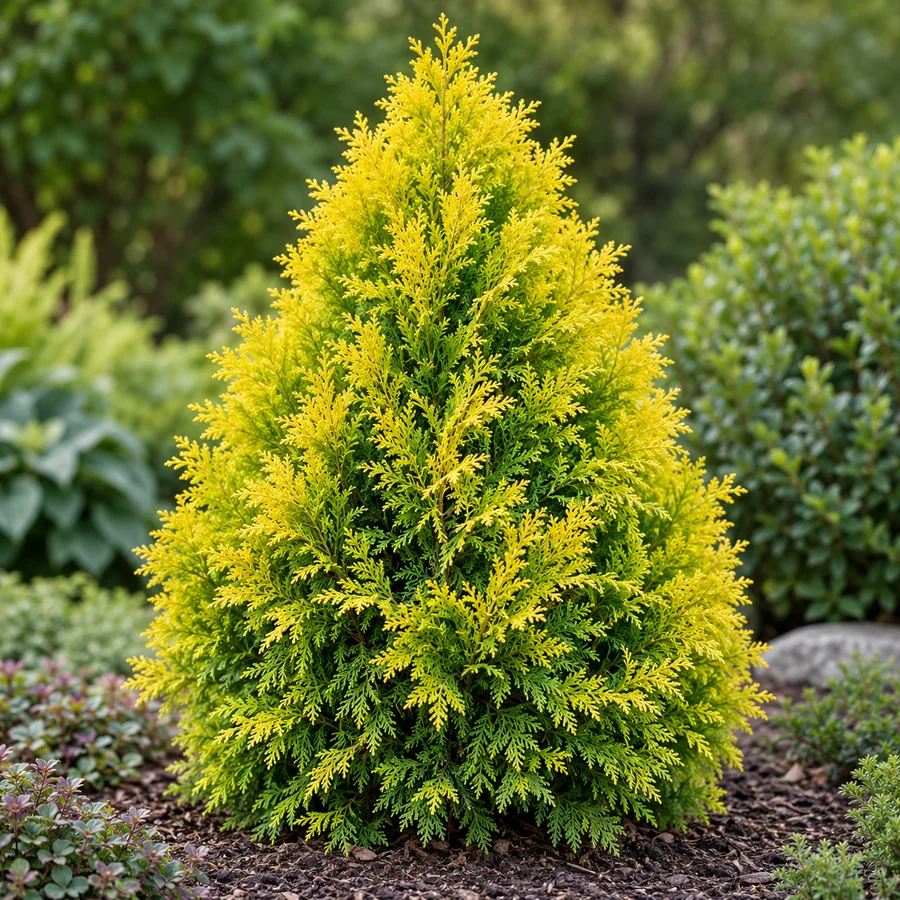
Western Arborvitae 'Aurea'
Thuja occidentalis 'Aurea'
Slow-growing coniferous shrub with golden-yellow foliage that turns reddish in cold periods. Compact conical form, ideal for alpine gardens, rock gardens, and container cultivation. Undemanding, frost-hardy, requires virtually no pruning. Warning: all parts of arborvitae (foliage, shoots, cones, seeds) are toxic if eaten due to the essential oil containing thujone — never use it for food or medicinal teas, and keep the plant and clippings away from children, cats, dogs and other animals; the resinous sap may irritate skin.
Stages of growth
Calendar in the garden
How to care
Plant seedlings in April–May (spring) or August–September (early fall). Position in a location sheltered from strong winds.
Abundant watering during the first 2–3 weeks after planting. Maintain moisture, but avoid waterlogging and standing water. During summer drought, water every 3–5 days.
- •Do not bury the root collar
- •Generously mulch the planting circle with wood chips or bark (3–5 cm)
- •Avoid fertilizing in the first year—it is not necessary
Difficulty growing
Suitable for beginners. Minimal maintenance, error-resistant.
Growing conditions
Soil preparation
Planting parameters
💡Preparation Tips
- •Dig the bed to a depth of 25-30 cm
- •Add compost or humus (5-10 kg per m²)
- •If necessary, adjust pH with lime or peat
Frequently asked questions(5)
This is normal—Western Arborvitae 'Aurea' becomes more copper and darker in the cold months (October–March). The color will return in spring. If yellowing occurs in summer, it may indicate insufficient moisture or spider mite damage.
Western Arborvitae 'Aurea' grows slowly and compactly, so pruning is barely necessary. You can remove damaged or poorly growing branches in April. Heavy pruning may ruin the natural form.
With good care—30–50 years or longer. The plant is long-lived and becomes increasingly beautiful with age.
Yes, it is one of the best conifers for containers. Use well-draining soil and water regularly in summer (pots dry out faster). In winter, move it to a cool unheated location or protect it from direct sun through glass.
This may result from overwatering, poor drainage, or fungal infections. Improve drainage, remove fallen needles, and thin the crown for air circulation. If brown spots are spreading, treat with a fungicide.
Role in the garden
Benefit information coming soon
Do you like the plant card?
In the application you will receive personal tasks and a plan for the season specifically for your garden.


