
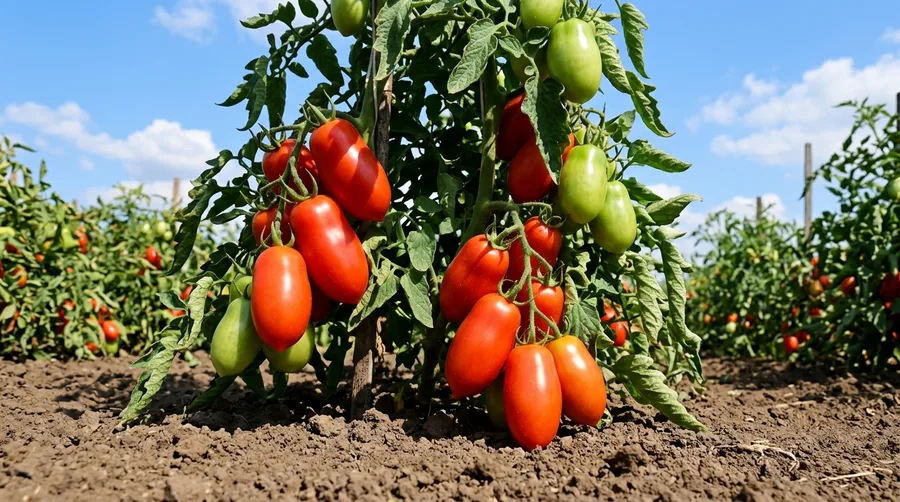
Solanum lycopersicum 'Rio Grande'
Solanum lycopersicum 'Rio Grande'
Determinate variety (United Genetics, USA; distributed in Russia through European and domestic seeds). The bush is compact, approximately 70–100 cm, with weak foliage. The fruits are red, cuboid-plum-shaped, about 100–110 g, dense pulp, thick skin - convenient for preservation and transport. According to catalogs - late ripening, guideline 125–130 days; yield in open ground is often indicated as 6–7 kg/m², planting ~5 bushes per 1 m². It is not listed in the State Register of Breeding Achievements of the Russian Federation.
Stages of growth
Planting calendar
How to care
Moist substrate before germination; film/lid on the box
- •Seedling method: sow ~55–60 days before planting (often late March).
- •In the south, direct sowing is possible with consistently warm soil - it shifts the ripening time.
Difficulty growing
Suitable for beginners. Minimal maintenance, error-resistant.
Growing conditions
Nice neighbors.
Unwanted Neighbors
Soil preparation
Planting parameters
💡Preparation Tips
- •Dig the bed to a depth of 25-30 cm
- •Add compost or humus (5-10 kg per m²)
- •If necessary, adjust pH with lime or peat
Frequently asked questions(5)
This is a determinate variety with a compact bush and calibrated fruits of plum-cuboid shape ~100–110 g. The pulp is dense, the skin is thick - convenient for preservation and transportation; the taste is sweet and sour, not “dessert” like some large varieties.
According to the descriptions in the catalogues, if there are a large number of clusters and fruits, it is better to tie up the bush - otherwise the branches may lie on the ground and be damaged. Stepping is moderate.
Reference books often indicate late dates for this variety: a guideline of 125–130 days from sowing (the exact date depends on the climate, greenhouse and care). In the middle zone, the harvest is usually from the second half of summer to the beginning of autumn.
This is a foreign selection (United Genetics); distribution through commercial seeds is not always accompanied by inclusion in the Russian register. This does not prohibit amateur cultivation, but for farms with requirements for varietal crops, it is worth checking the current standards.
In open ground, reviews often cite 6–7 kg/m²; from a separate bush in a greenhouse, reviews also show higher numbers with good care. Much depends on planting density (~5 bushes/m²), nutrition and watering.
Benefits and nutrition
Tomatoes are rich in lycopene, vitamin C and potassium; dense fruits are convenient for harvesting for the winter. Do not replace medical advice.
*The information is for informational purposes only and does not constitute medical advice.
Nutritional value
(per 100 g)| Calories | 18 kcal | 0,9% |
| Carbohydrates | 3.9 g | 3% |
| Squirrels | 0.9 g | 1,8% |
| Fats | 0.2 g | 0,3% |
| Dry matter (guideline for variety) | 4,8–5,0% | — |
| Potassium | 237 mg | 5% of the daily value (guideline) |
% of daily value
Do you like the plant card?
In the application you will receive personal tasks and a plan for the season specifically for your garden.