
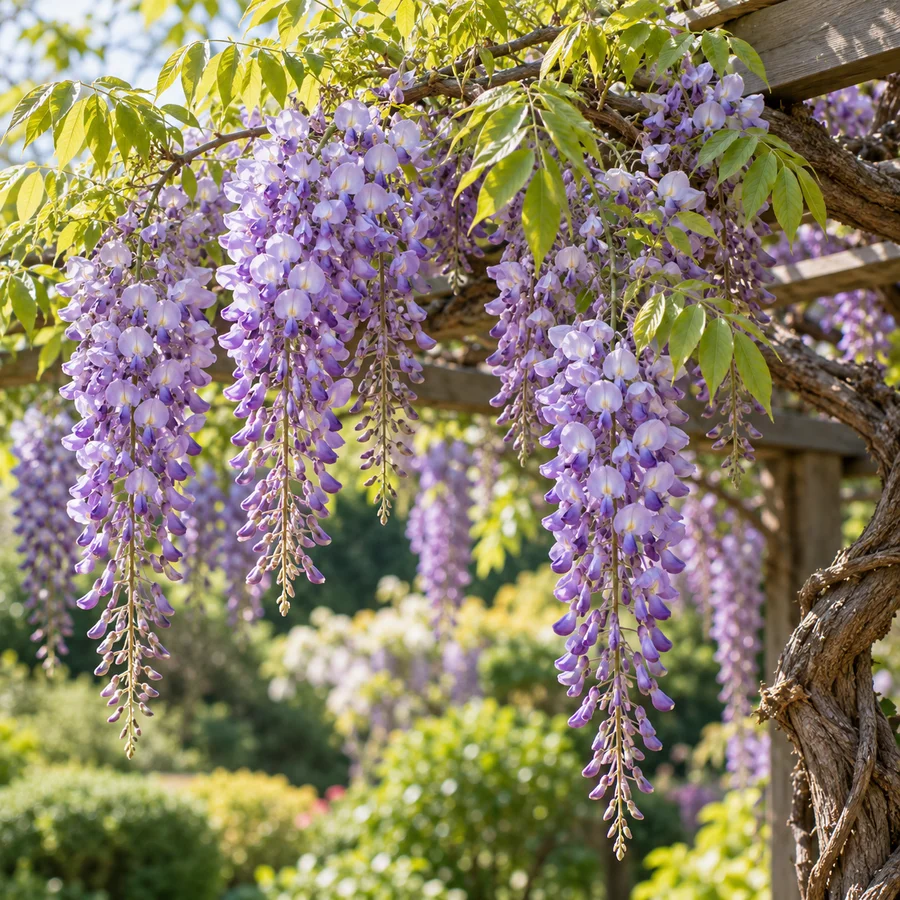
Wisteria
Wisteria
Beautiful climbing vine with long drooping racemes of purple, pink, white or blue flowers. Blooms abundantly in spring and partially in summer. Requires a sturdy support, good lighting, and regular pruning for shaping and abundant flowering. Warning: all parts of wisteria are toxic, especially the seeds and velvety pods (the lectin wisterin) — never eat them, and keep the plant away from children, cats, dogs and other pets.
Stages of growth
Calendar in the garden
How to care
Abundant watering on planting day and for 2 weeks after
- •Dig a hole 2–3 times larger than the seedling's root ball
- •Add 10–15 cm of drainage and organic matter to the bottom
- •Carefully transfer the seedling without breaking the soil ball
- •Tie to the support with soft material
Difficulty growing
Requires basic knowledge and regular care.
Growing conditions
Soil preparation
Planting parameters
💡Preparation Tips
- •Dig the bed to a depth of 25-30 cm
- •Add compost or humus (5-10 kg per m²)
- •If necessary, adjust pH with lime or peat
Frequently asked questions(5)
The best time is early spring (March–April) or autumn (October–November). Seedlings establish best during mild weather. Spring planting is preferable in cold climates to allow the seedling to root before winter.
Main reasons: insufficient sunlight (less than 4–6 hours daily), young plant age (first flowers in 3–4 years), excess nitrogen in soil (promotes foliage over flowers), improper pruning. Limit nitrogen fertilizer and perform timely summer pruning.
Perform two prunings per year: summer (July–August) — shorten lateral shoots by 20–30 cm, leaving 6–8 buds from the base; winter (December–February) — cut remaining shoots back by another 5–7 cm. Correct pruning promotes abundant flowering and maintains vine shape.
Wisteria is cold-hardy to -25° (zones 4–9), especially when planted against a protected wall. In severe winters, young shoots may be frost-damaged, but the plant usually recovers from the roots. In northern regions, protect the base and young parts with evergreen branches or frost cloth.
A sturdy vertical or horizontal support is required: trellis, pergola, fence, arbor, or strong wire on a wall. Use metal structures, as mature plants can weigh 50–100 kg. Avoid bare wooden supports, which vines quickly damage when twining around them.
Role in the garden
Beautiful climbing vine with long, drooping clusters of purple, pink, white, or blue flowers. Blooms abundantly in spring and partially in summer. Attracts pollinators.
*For reference: the plant is grown primarily as an ornamental.
Do you like the plant card?
In the application you will receive personal tasks and a plan for the season specifically for your garden.


